
Editor’s note
- Assessing the debt burden and the tax dilemma: will the citizen become a fiscal victim?
- Debt ratio versus the reality of the debt service ratio (DSR)
- Diminishing fiscal headroom
- Tax reform and the potential burden on the middle class
- Towards sustainable management
Assessing the debt burden and the tax dilemma: will the citizen become a fiscal victim?
The Indonesian government’s debt position is currently at a critical point and is approaching the psychological figure of 10,000 trillion Indonesian rupiah.
This staggering amount is not only a statistical fact but also a cause for concern for various groups, including the Indonesian House of Representatives (DPR RI).
Amidst this fiscal pressure, the government is being urged to think creatively about increasing state revenues, particularly from the tax sector. The question, however, is: is this solution suitable, or will it actually suppress the purchasing power of the population?
Debt ratio versus the reality of the debt service ratio (DSR)
Normally, the government often reassures the public by stating that Indonesia’s debt position still falls within “safe limits.” This refers to the debt-to-GDP ratio, which remains below the legally established threshold.
However, some economists disagree with this. They argue that the debt-to-GDP ratio is insufficient to paint a complete picture of Indonesia’s financial health.
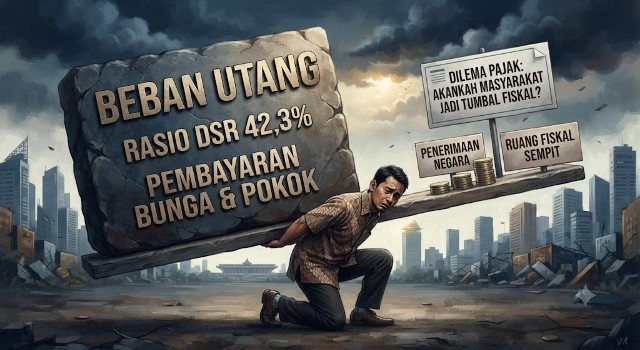
Attention has now shifted to the debt service ratio (DSR), an indicator that measures how much of state revenue is used exclusively to pay debt repayment and interest.
Data from 2024 shows a DSR of 42.3% for Indonesia. This means that nearly half of all state revenue is used exclusively for debt service.
This figure is far above the ideal standard for sound financial management by the state.
Limited financial leeway
The dependence on state revenue for the repayment of the national debt creates a harmful domino effect. The government’s financial leeway is severely limited. Money that should be earmarked for productive sectors—such as sustainable infrastructure development, improving the quality of education, healthcare, and social safety nets—must be “locked up” to meet debt obligations.
LATEST NEWS: Early detection of mental disorders through a free health check program
As a result, the government finds itself in a dilemma: on the one hand, it must repay the debt; on the other, public needs continue to increase.
Tax reform and the potential burden on the middle class
In response to this situation, the Indonesian House of Representatives (DPR RI) encourages the government to implement tax reform to increase state revenues.
Although the tax burden in Indonesia is indeed low compared to many developed countries, attempts to broaden the tax base and increase tax compliance carry their own risks.
LATEST NEWS: North Sumatra aims for 7.3 million free health checks
The greatest concern is who will bear this additional burden. To date, the middle class has often been the largest contributor to tax revenues. If tax policy is not carefully designed, there is a significant risk that this burden will erode people’s purchasing power and impede national economic activity.
Towards sustainable management
The debate on debt and taxes is not merely an attempt to fill the state coffers. It is about fiscal sustainability.
In the future, the government cannot simply rely on an approach of “collecting more taxes.”
A more holistic strategic approach is needed, namely:
1. Efficient spending: ensuring that every rupee of the state budget is spent effectively and purposefully.
2. Qualitative economic growth: creating a strong economic climate to naturally increase the revenue base.
3. Prudent debt management: ensuring that debt is managed sustainably without creating an excessive burden for future generations.
LATEST NEWS: SI MiKE SU brings the 11th North Sumatra Scout Jamboree to life
Ultimately, successful public financial management rests on the balance between meeting debt obligations and ensuring that the population is not suffocated by an unequal tax burden.
The government must demonstrate that tax reform is a path to development, and not merely a quick fix to close the debt gap. ***tok