
Editor’s note
- Analysis of the WIFI stock: a pioneer of Wi-Fi 7 technology in Indonesia
- Strongly rising financial performance
- Company transformation into growth engine
- Pioneer in Wi-Fi 7 technology
- Aggressive infrastructure expansion
- Valuation: High optimism, but still requires realism
- Risks that must not be ignored
Analysis of the WIFI stock: a pioneer of Wi-Fi 7 technology in Indonesia
The WIFI stock is one of the most discussed stocks on the capital market. On the one hand, analysts estimate the price target for this stock at approximately IDR 4,000.
On the other hand, a surprising calculation has emerged, based on Warren Buffett’s valuation method, which yields a fair value of nearly IDR 72,000 per share.
LATEST NEWS: Kahiyang Ayu distributes student grants to 118 talented students from underprivileged families
This significant difference certainly raises an important question: does the WIFI stock really have so much potential, or should investors be more cautious?
Strongly rising financial performance
One of the main reasons for the increased interest from investors is the company’s impressive financial performance. In the third quarter of 2025, operating profit rose by 127%. This performance immediately attracted the attention of both institutional and private investors.
This positive momentum continued into the first quarter of 2026. Net profit nearly doubled compared to the same period last year, reaching approximately 164.5 billion Indonesian rupees. At the same time, the company’s revenue increased by 238%.
Even more impressive is that the company has managed to maintain profitability amidst massive expansion. The net profit margin remains above 35%, the return on equity (ROE) is around 23%, and the debt-to-equity ratio remains around 0.82.
This combination of high growth and maintained profitability has made many investors increasingly optimistic about the company’s prospects.
Transforming the company into a growth engine
This growth is no coincidence. The company is undergoing a major transformation in its business model. Whereas it previously focused primarily on the business (B2B) segment, the company has now aggressively entered the retail market (B2C). This strategy has proven effective, as approximately 45% of revenue now comes from retail customers.
This change of course offers significantly greater growth opportunities, as the consumer market has a much broader customer base than the business market.
Pioneer in Wi-Fi 7 technology
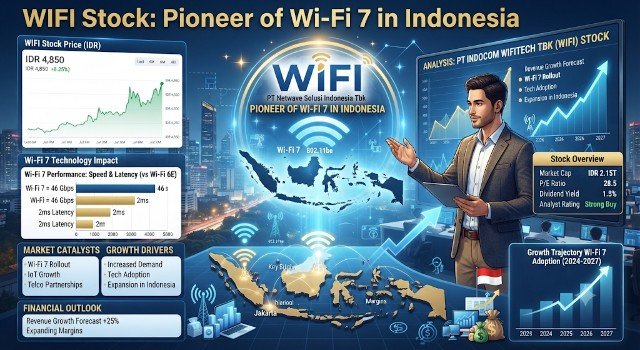
One of the key drivers for the company is the adoption of Wi-Fi 7 technology.
The company is a pioneer in the implementation of Wi-Fi 7 networks in Indonesia. During a trial at a high school in Denpasar, download speeds of approximately 2 Gbps were achieved. At this speed, a 1 GB file can be downloaded in just a few seconds.
LATEST NEWS: Cooperation to improve healthcare on the Nias Islands
This technology has the potential to be a game changer for the national internet infrastructure, especially as the demand for high-speed connections continues to grow.
Aggressive infrastructure expansion
To support this growth, the company is undertaking a large-scale network expansion. In the first phase, the company successfully realized approximately 2.5 million fiber optic connections for households.
In the second phase, the company aims for:
– Reaching approximately 3.2 million wireless subscribers.
– The construction of approximately 5,500 new transmission towers by the end of 2026.
This expansion is supported by three key factors.
First, the company won the auction for the strategic 1.4 GHz frequency, which forms the basis for the development of wireless internet services.
LATEST NEWS: These are the three most prestigious schools in Indonesia
Second, the company secured the support of an international strategic partner, NTT East from Japan, which has strengthened technological capabilities and network development.
Third, the company secured a fiber optic network of approximately 8,000 kilometers along the railway lines on the island of Java. This infrastructure offers a competitive advantage that is difficult for competitors to match.
Valuation: High optimism, but remains realistic
Regarding valuation, the majority of analysts still recommend a price target of approximately 4,000 Indonesian rupees per share.
However, an analysis has appeared on social media using a Warren Buffett-style valuation method, with an estimated fair value of nearly 72,000 Indonesian rupees per share.
LATEST NEWS: Seizing an opportunity to earn twenty times as much: The art and strategy of investing in growth stocks
While these figures certainly stand out, they must still be considered theoretical scenarios dependent on various assumptions regarding long-term growth.
Investors should not focus solely on potential price increases but also take into account the risks associated with a company’s expansion.
Risks that must not be ignored
Rapid growth requires significant investments.
The company’s capital expenditures (capex) amounted to approximately 3.1 trillion Indonesian rupees. As a result, total debt rose to approximately 5 trillion Indonesian rupees.
Another consequence is that operational cash flow remains negative, as the majority of resources are used for infrastructure development and network expansion.
LATEST NEWS: Labor relations must adapt to the changing labor market
As long as this expansion generates sustained revenue growth, this situation is understandable. However, if customer growth slows or revenue falls short of targets, the debt burden could become a significant challenge for the company.
Conclusion
WIFI is in a very aggressive growth phase. The company has successfully realized significant profit increases, expanded market share through a B2C strategy, and strengthened its position as one of the pioneers of Wi-Fi 7 technology in Indonesia.
Support from new frequencies, international strategic partners, and an extensive fiber optic network are key assets for long-term growth. However, behind the promising outlook lie risks that must be taken into account. Large capital expenditures, increasing debt, and persistently negative operating cash flow are factors that must be monitored regularly.
For investors, investment decisions should be based not only on potential returns but also on the balance between growth opportunities and the risks the company faces.
LATEST NEWS: Safrianto Zuriat Putra becomes coordinator of the special task force for combating crime
The big question now is: will WIFI be able to reach analysts’ price targets of around 4,000 rupiah, or will it exceed expectations and achieve a much higher valuation in the future?
The answer will largely depend on the company’s success in executing its expansion strategy while maintaining financial health. ***tok