Regional authorities encouraged to jointly manage social media
The Provincial Government of North Sumatra (Pemprov) encourages all social media managers of regional government agencies (OPDs) to strengthen cooperation in developing informative, responsive, and adaptive public communication that responds to digital developments.
Through this synergy, information regarding development and public services is expected to be disseminated faster, reach a broader audience, and be more easily accessible.
LATEST NEWS: Bobby Nasution Receives Adinata Syariah Prize
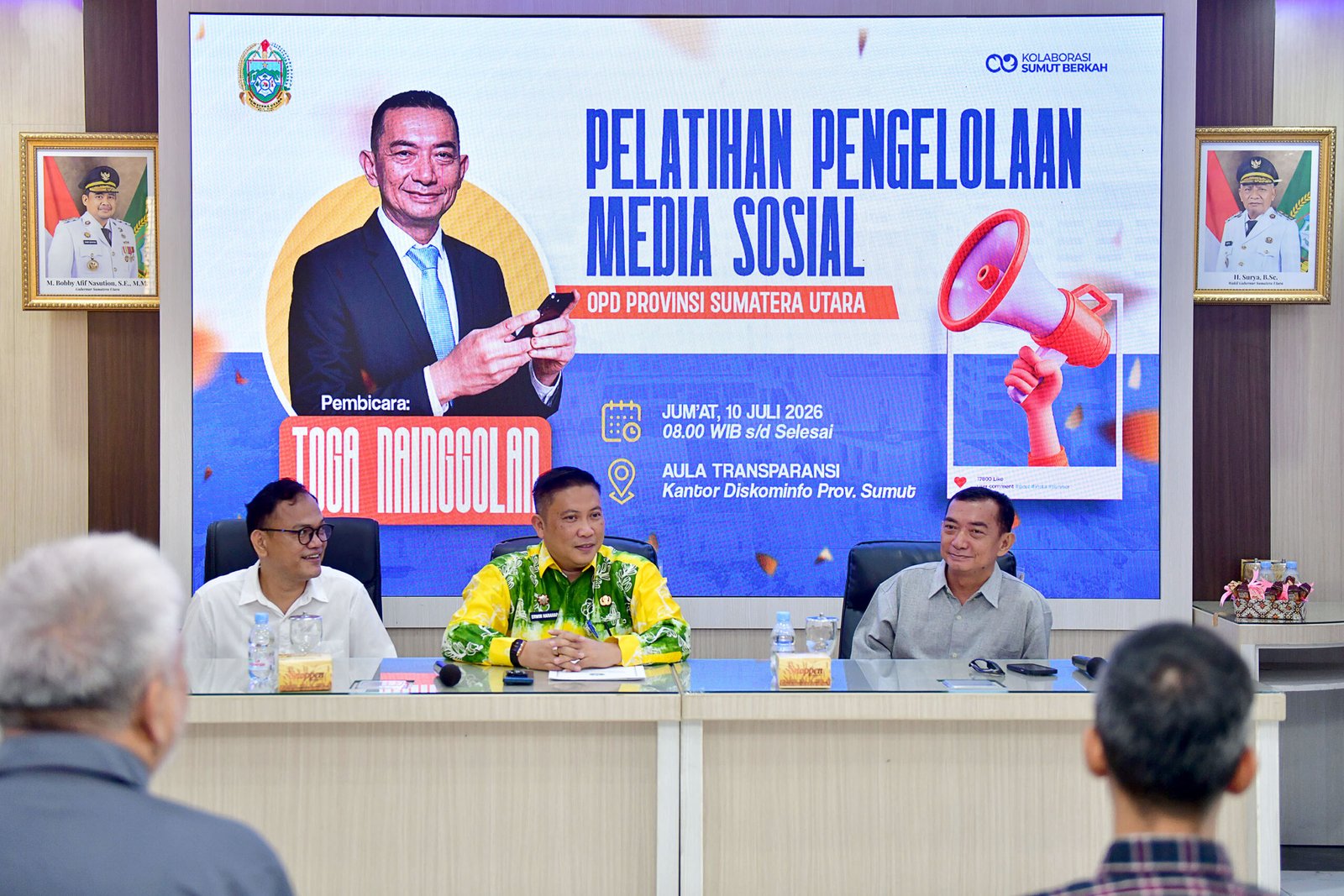
“Today, social media is not just a communication channel, but has evolved into a platform for public service delivery and a real-time means of communication between the government and citizens. Social media also requires a fast, accurate, and measurable response, especially when citizens submit questions, requests, and complaints,” stated Erwin Hotmansah Harahap, Head of the Bureau for Communication and Information (Kominfo) of North Sumatra, during the opening of the Technical Guidelines (Bimtek) for Social Media Management for Provincial Government Agencies in North Sumatra in the Transparency Hall of the Kominfo office in Medan.
According to him, content published by the government must not only be engaging but also accurate, useful, comply with public access regulations, and win the public’s trust. Therefore, the social media managers of the North Sumatra Provincial Government must continuously improve their skills in information management, strategic issues, and combating disinformation.
“Let us work together so that the work programs of the North Sumatra Provincial Government become known to the entire public. Do not focus solely on the activities of each individual provincial government. Let us innovate,” he urged.
Social media activist Toga Nainggolan was present as an expert during the technical training. He provided information on comprehensive social media management, ranging from strategies to capitalize on digital trends to building organic interactions with the public.
Participants are expected not only to acquire theoretical knowledge during this training but also to be able to apply it directly to their work within their respective agencies. In his presentation, Toga outlined the changes in the way the public consumes information, noting that social media is now more important than print media.
Based on his data, 88.9% of adults (18 years and older) use social media, making digital platforms a highly strategic communication channel for the public. Furthermore, the average person spends 21 hours and 50 minutes per week, or about three hours a day, on social media.
He also explained that people nowadays prefer lighthearted content over official government information. According to him, this is influenced by the workings of the human brain, which is biologically inclined to seek information that is easy to understand, offers immediate gratification, prevents cognitive fatigue, and serves as a way to escape the pressures of daily life.
LATEST NEWS: Preventing North Sumatra Fishermen from Crossing Indonesian Waters
“A change has occurred in people’s communication behavior. People want it fast and do not want to know the technical details. Communication is simple, as long as the problem is solved. People also prefer visual content, no longer find long texts pleasant, and dialogue is no longer one-way traffic. The public judges not only how the government works, but also how it communicates,” he said. ***rel