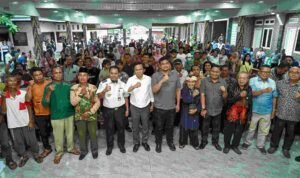

Medan Hajj Hospital continues to improve facilities and staff
Since its introduction in October 2025, Medan Hajj General Hospital (RSU) has helped 1,099 residents of North Sumatra through the free, priority universal health care program (UHC).
As the number of people utilizing these services increases, Medan Hajj Hospital continues to strengthen its capacity by expanding the number of beds, care facilities, and medical staff.
“In support of the Free Healthcare (Probis) and Priority UHC initiatives initiated by the Governor, Medan Hajj Hospital, as a referral hospital, is taking on the role of welcoming residents of North Sumatra in need of care by offering them direct access to care,” stated Ridesman Nasution, Deputy Director of General Affairs and Personnel Development at Medan Hajj Hospital, during a press conference of the North Sumatra Communication and Information Bureau (Kominfo) in the North Sumatra Dekranasda lobby at the North Sumatra Governor’s office in Medan.
Ridesman explained that of the 1,099 patients who benefited from the Priority UHC program, 738 were admitted to the hospital, 360 were treated on an outpatient basis, and only one patient was referred to Adam Malik Hospital for more extensive treatment.
“This demonstrates our commitment to supporting the free medical care program. We strive to provide the best possible service. Of the 1,099 patients, only one was referred to Adam Malik Hospital for more extensive treatment,” he said.
According to Ridesman, Medan Haji Hospital offers the same care to all patients, regardless of their health insurance status.
“We make no distinction between residents who come to us for care, regardless of whether they pay their healthcare costs themselves through BPJS (Social Security), or whether they already have BPJS coverage or no health insurance at all. We offer all healthcare services according to standard procedures. Even if a resident’s BPJS card is no longer valid, we register them and the card can be used again within 3 x 24 hours, without having to wait 14 days,” he explained.
To anticipate the expected increase in the number of patients, Medan Hajj Hospital is continuously expanding the capacity of its facilities and infrastructure.
The Intensive Care Unit (ICU) has been expanded from 10 to 15 beds, the Neonatal Intensive Care Unit (NICU) from 7 to 20 beds, and the Emergency Department (ED) from 16 to 27 beds.
The renovation of the NICU has been completed, while construction of the ICU and the ED is still ongoing and is expected to be completed in December 2026.
“In addition to the facilities, we are also expanding our staff, particularly specialists, and adding medical equipment to improve care for cancer, cardiovascular diseases, strokes, kidney diseases, and maternal and child care, so that in the future we will no longer need to refer patients to other hospitals,” said Ridesman.
Meanwhile, Fitrady Ulianda Siregar, Acting Deputy Director of Medical Services and Nursing at Medan Hajj Hospital, stated that the results of the performance evaluation demonstrate that the quality of care at Medan Hajj Hospital continues to improve.
“Based on the performance evaluation data, there are three indicators we can observe: bed occupancy, average length of stay, and the public satisfaction index. By 2025, all three departments of the Hajj Hospital – inpatient care, outpatient care, and the emergency department – will show an increase,” he said.
Based on data from 2025, the number of inpatients at the Hajj Hospital in Medan will increase by 20.42%, the number of outpatients by 18.20%, while the emergency department will show the largest increase, namely 34.24%. ***rel