Editor’s Note
- Prabowo’s policy changes address the leakage of national wealth
- State-owned enterprises become the sole exporters of strategic raw materials
- Effective date: September 1, 2026
- Obligation to retain foreign currency export earnings (DHE)
- Increased foreign exchange reserves
Prabowo’s policy changes address the leakage of national wealth
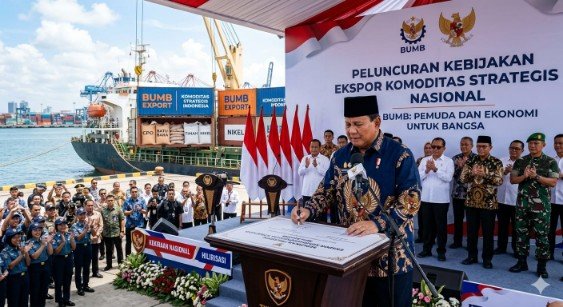
The Indonesian government under President Prabowo Subianto will implement a fundamental reform in the management of natural resource exports.
This change is intended to address the massive leakage of national wealth resulting from under-invoicing and transfer pricing practices.
LATEST NEWS: Stop the inflation of your lifestyle: a salary of 3 million rupiah can be enough if you have a clear financial plan
The proposed radical solution is to make state-owned enterprises the sole exporters of strategic raw materials such as palm oil and coal, thereby taking over the role of private companies. This new plan is being introduced gradually in two phases, starting with a transition period from June 1, 2026, to August 31, 2026, followed by full implementation on September 1, 2026.
Furthermore, the government requires that 100% of foreign currency proceeds from the export of natural resources be deposited into domestic bank accounts for at least three months, with the exception of the oil and gas sector, where 30% is required.
This policy is expected to increase foreign currency reserves to more than 100 billion dollars per year.
Although the stock market initially reacted negatively due to investor concerns regarding the short transition period, disruptions to international contracts, and the logistical readiness of state-owned enterprises, the government is optimistic that this policy will counter the leakage of state assets and improve public welfare.
LATEST NEWS: 5 natural drinks for kidney cleansing: analysis and benefits for the body
State-owned enterprises become the sole exporters of strategic raw materials
To counter this leakage, the government has implemented a radical solution by making state-owned enterprises the sole exporters. Domestic private companies are required to sell their raw materials through state-owned enterprises before passing them on to foreign buyers.
State-owned enterprises (SOEs) will act as mandatory gatekeepers or sole cashiers for strategic raw materials such as palm oil and coal. President Prabowo has decreed that all sales must be conducted through government-designated state-owned enterprises.
With state-owned enterprises as the sole marketing facilitators, the government has direct oversight to monitor transactions, guarantee fair prices, and combat tax evasion and capital flight.
LATEST NEWS: Minister of Manpower emphasizes that employees must strengthen innovation amid global changes
Effective as of September 1, 2026
From June 1 through August 31, 2026, exporters were given three months to transfer their transactions to state-owned enterprises.
Full implementation began on September 1, 2026, whereby all contracts with foreign buyers are handled entirely by state-owned enterprises.
Although state-owned enterprises retain control over the contracts, the physical export process still goes through three bureaucratic phases: pre-settlement (legality), settlement (customs clearance, payment of export duties, loading of goods), and post-settlement (payment via banks).
Obligation to withhold export proceeds (DHE)
As of June 1, 100% of foreign currency proceeds from the export of natural resources must be deposited into domestic Himbara banks and held there for at least three months. An exception to this applies to the oil and gas sector, where the limit is 30%.
LATEST NEWS: Gold Price Forecast and Analysis Today, Wednesday, May 20, 2026: Wait and See
A maximum of 50% of the DHE funds may be exchanged for rupiah; the remainder can be freely used for paying taxes, purchasing resources, or repaying foreign debt.
Increase in foreign currency reserves
The government expects that this foreign currency withholding policy will generate more than 100 billion dollars in additional foreign currency reserves within a year. The stock market reacted negatively to the announcement of the establishment of the state export agency, causing the Jakarta Composite Index (JCI) to fall into the red.
Investors were concerned about the transition period, which was considered too short (three months), the potential disruption of existing international trade contracts, and the logistical readiness of state-owned enterprises to manage a complex international trade network. ***tok