
Editor’s note
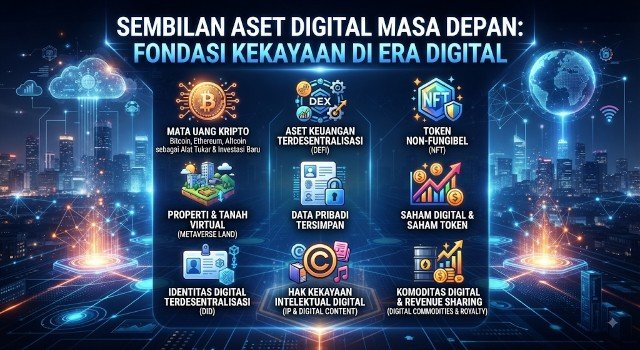
- Nine digital assets of the future: the foundation for wealth in the digital age
- From consumer to builder
- Nine digital assets to build
1. Digital skills
2. Personal branding
3. Loyal community
4. High-quality content
5. Copyright
6. High-traffic website or blog
7. Customer database or email list
8. Software or applications
9. Digital portfolio - Consistency is key
- Blueprint for building digital assets
- Stop chasing a paycheck; start building assets
- Digital assets never sleep
- The key to financial freedom
- Start with one skill today
Nine digital assets of the future: the foundation for wealth in the digital age
The definition of wealth is undergoing a major shift. For years, wealth was synonymous with houses, land, gold, vehicles, or money in the bank.
In the digital age, however, a new form of wealth has emerged that isn’t always physically tangible: digital assets.
LATEST NEWS: Work More Efficiently with Galaxy AI on the Galaxy Z Fold8 Ultra
Digital assets exist on the internet, can reach a massive market, and—under the right conditions—can continue to generate value even when their owners are inactive.
An article written years ago can still be found via search engines. A digital course can be sold repeatedly. An app can serve thousands of users simultaneously.
This makes understanding digital assets all the more important.
From consumer to builder
There is one important question we must ask ourselves: are we building our own digital assets, or are we merely helping to build someone else’s?
Every day, we spend time on social media, watching videos, reading articles, commenting, and interacting with various platforms.
These activities aren’t necessarily bad. But if we spend all our time consuming, we are essentially helping to create value for platform owners, creators, and other businesses. That is why our mindset needs to change. Don’t be a spectator. Start becoming a builder.
LATEST NEWS: North Sumatra Accelerates Development in Four Nias Islands Regions
You don’t have to own a major tech company right away. Creating a useful video, writing an article, starting a blog, building a portfolio, or learning a new skill are all initial steps toward creating digital assets.
Nine digital assets to build
There are at least nine digital assets that can form the foundation for future wealth.
1. Digital skills
Skills are inherent assets.
The ability to use AI, graphic design, programming, data analysis, digital marketing, video editing, and even automation can hold significant economic value.
Technology is constantly changing. That is why the ability to learn and adapt is even more important than mastering a specific technology.
Someone who continuously improves their skills is more likely to create new value as technology evolves.
2. Personal branding
A trusted name is a valuable asset. When someone is known for specific skills and trusted by others, economic opportunities can arise in various forms: jobs, projects, consulting work, collaborations, product sales, and even business ventures.
Personal branding is about more than just having a large following. Reputation is far more important.
Follower counts can fluctuate, but a reputation built on consistency and credibility holds long-term value.
LATEST NEWS: Bobby Nasution ensures resident complaints are addressed immediately from Nias
3. A loyal community
Having an audience is great. But having a community that trusts you is far more valuable.
A thousand people who truly trust us can be more valuable than tens of thousands of followers who never engage. A community is an asset because it fosters relationships, trust, care, and an understanding of needs.
When a community grows healthily, it can serve as the foundation for various digital products and businesses.
4. High-quality content
Content can also be an asset. A video, article, podcast, or piece of educational material created today can remain discoverable and provide value for years to come.
Good content is not just about immediate virality. Strong content offers information, education, inspiration, or entertainment that remains relevant.
In this way, every piece of high-quality content created can become part of a personal digital library.
LATEST NEWS: Galaxy Z Fold8 Ultra upgraded with new 200MP and 50MP ultra-wide cameras
5. Copyright
Intellectual property can be a valuable asset that generates recurring value.
E-books, music, photography, designs, illustrations, courses, templates, software, and various other creative works can hold economic value, provided there is a market for them and the rights are properly protected.
The advantage is that a single work can be used by or sold to many people without the product needing to be recreated from scratch for every transaction.
This is a key characteristic of the digital economy: reproduction costs can be very low, while market reach can be very broad.
6. High-traffic website or blog
A website with a large number of visitors is comparable to a strategically located store on the internet.
Every day, people find their way to you via search engines, links, social media, or other sources.
This traffic can then be converted into various forms of value, such as advertising revenue, product sales, services, affiliate marketing, or relationship-building with potential customers.
The difference is that a physical store is tied to a specific location. The internet allows a website to reach people across different regions and even countries.
LATEST NEWS: 46,160 participants begin internship program (Batch II, Batch 1)
7. Customer database or email list
One of the most important digital assets is the ability to communicate directly with people who already know and trust us.
Social media allows us to build an audience, but content distribution can be influenced by platform algorithms.
A customer database or email list offers a more direct line of communication.
When someone voluntarily provides their contact details because they are interested in the products or information we offer, that relationship can evolve into a valuable long-term business asset.
8. Software or applications
Software and applications are digital assets capable of automatically solving problems.
A single application can be used by many people simultaneously. If an application solves a real problem and has the right business model, it can generate value on a scale that is difficult for companies relying entirely on human resources to achieve.
Not everyone needs to be a programmer.
However, understanding the problem to be solved, user needs, and how technology can be used to create solutions is an increasingly important skill.
9. Digital portfolio
A digital portfolio showcases a person’s skills. Instead of simply saying, “I can design,” one can display their design work.
Instead of simply saying, “I can write,” one can show articles they have written.
Instead of simply saying, “I understand AI,” one can showcase successful projects developed using AI.
A portfolio turns claims into evidence.
The stronger the portfolio, the easier it is for others to understand the skills and value a person can offer.
Consistency is the most important asset
Interestingly, building digital assets does not always require a large amount of capital.
The most important assets are time, a willingness to learn, adaptability, and consistency.
Many people fail not because they lack money, but because they give up too soon.
They create content for a week and then stop. They learn for a few days and then quit. They create their first product and are disappointed that it doesn’t generate revenue immediately.
LATEST NEWS: Three Development Priorities for the Nias Islands
Building assets, however, takes time.
A single piece of content might not amount to much. Ten pieces of content can form a library. A hundred pieces of content can build authority. Thousands of interactions can form a community.
That power comes from accumulation.
Blueprint for building digital assets
The process can start very simply. Step one: learn one valuable skill.
You don’t have to learn everything at once. Choose one in-demand skill and practice it consistently.
Step two: share your knowledge through content.
Document what you’ve learned. Offer solutions to other people’s problems. Build a reputation and earn trust.
Step three: turn your knowledge into a product.
Once you have the expertise and your audience’s trust, you can develop that knowledge into an e-book, course, template, service, piece of software, paid community, or other digital product.
Then the cycle repeats: Learn → create → build an audience → create a product → gain experience → learn again.
What drives this cycle isn’t the size of your wallet, but consistency.
LATEST NEWS: Consumer purchasing power is under pressure: 7 signs you can’t ignore
Stop chasing a salary; start building wealth
A salary remains important. For most people, active income forms the foundation of their lives.
However, problems arise when someone relies on a single source of income and never builds anything capable of growing beyond their working hours.
A short-term mindset asks:
“How much am I getting paid this month?”
A long-term mindset begins to ask:
“What assets am I building today?”
The difference is significant.
A salary provides income based on work performed. Assets can continue to generate value after the initial work is done—though, of course, not all digital assets automatically generate income, and they still require maintenance.
The goal is not to stop working.
The goal is to use today’s work to build something that holds value far beyond a single paycheck.
LATEST NEWS: The Galaxy Z Fold8 Ultra gets upgrades with new 200MP and 50MP ultra-wide cameras
Digital assets are tireless
One of the advantages of digital assets is their scalability.
Content never sleeps. Websites never take time off. Digital products are accessible at any moment. Software can serve many users simultaneously.
Unlike physical stores, digital assets know no geographical boundaries.
Work created in Indonesia can be discovered by people in other countries.
However, it is important to remember that “working automatically” does not mean digital assets are entirely cost-free or maintenance-free. Platforms can change, technology can become obsolete, algorithms can shift, and consumer needs are constantly evolving.
That is why digital assets require continuous maintenance and development.
The key to financial freedom
Financial freedom is not just about having a high income.
What matters more is having systems and assets capable of creating long-term value. People who rely solely on their time and energy have limited capacity. In contrast, those capable of building systems, products, reputations, communities, and digital assets have the opportunity to expand their economic reach.
That is why the future belongs not only to those who work the hardest, but also to those who can build something that retains value long after the work is done.
LATEST NEWS: The Galaxy Z Fold8 Ultra gets upgrades with new 200MP and 50MP ultra-wide cameras
Start with just one skill today.
You don’t need an expensive camera. You don’t need thousands of followers.
You don’t need to be an expert. You don’t need to wait for everything to be perfect.
Start with one skill. Create one piece of content. Build one portfolio. Write one article. Learn one technology. Develop one simple product. And repeat.
Small steps taken consistently can grow into significant assets over the years.
Ultimately, the most important question isn’t:
“How much money do I have today?”
But rather: “What assets am I building today that will still be valuable in the future?”
The digital age offers almost everyone the opportunity to be a creator, not just a consumer.
So, choose a digital asset that best aligns with your skills and interests. Start working on it now.
Because future wealth may depend not only on what we own in the physical world, but also on what we create in the digital world. ***tok