Editor’s note
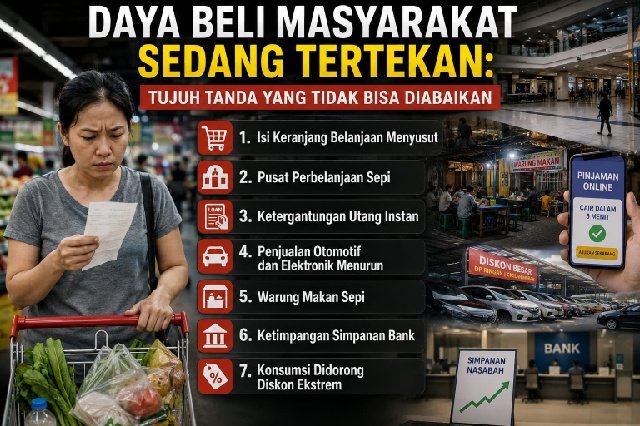
- Consumer purchasing power is under pressure: 7 signs you can’t ignore
- Shopping baskets are getting smaller
- Shopping malls are busy, yet few transactions are taking place
- Quick loans are becoming a solution
- The automotive and electronics sectors are coming under pressure
- Food stalls are also feeling the impact
- Inequality in savings is becoming increasingly visible
- Consumption is becoming increasingly dependent on discounts
- The middle class finds itself in a difficult position
Consumer purchasing power is under pressure: 7 signs you can’t ignore
The market is currently grappling with a far more serious issue than merely fluctuating sales figures. An increasingly noticeable phenomenon is the decline in people’s purchasing power.
You can no longer buy the same amount of goods for the same sum of money as before. Spending is still happening, but shopping baskets are getting smaller.
LATEST NEWS: Attorney General Swears In Dozens of Senior Prosecutors and Second-Echelon Officials
At the same time, shopping malls seem quieter, sales of cars and electronics are dropping, food stalls are losing customers, and the use of quick loans is on the rise.
When these phenomena occur simultaneously, the question is no longer whether purchasing power is under pressure, but rather how acutely the public is feeling that pressure.
Shopping basket contents are shrinking
The simplest indication of this can be seen in everyday shopping habits.
Previously, one could buy a substantial amount of household essentials for 500,000 rupiah. Now, that same amount seems to run out much faster.
The prices of goods are rising, while incomes are not always keeping pace. As a result, people are beginning to adapt. Products once taken for granted are being replaced by cheaper brands, and purchases of non-essential items are being postponed. Even purchases of essential items are becoming less frequent.
It is not just a matter of rising prices; more importantly, money’s ability to cover the cost of living is diminishing.
LATEST NEWS: Bobby Nasution’s Activities During His Visit to the Nias Islands
Busy shopping malls, yet few transactions
A specific phenomenon can be observed in shopping malls.
While malls may remain crowded, high foot traffic does not always translate into more transactions. Some people visit simply to browse, be entertained, enjoy the air conditioning, or kill time without buying anything.
This is often referred to as ‘window shopping.’
The desire to consume remains, but financial means are becoming more limited. People still want to buy clothes, dine out, replace gadgets, or seek entertainment, yet an increasing number of purchasing decisions are ultimately being postponed.
In other words, the urge to consume has not vanished, but the underlying purchasing power is declining.
LATEST NEWS: BMKG Enhances Disaster Knowledge Among the Younger Generation
Quick loans as a solution
The strain on purchasing power is also evident in the growing reliance on online loans and ‘buy now, pay later’ services.
For some, quick loans seem like an immediate solution. When cash is scarce, needs can still be met through deferred payment.
The problem arises when debt is used to cover daily expenses rather than for productive purposes. New debt is incurred to pay off old debt. Next month’s income is often already spoken for—consumed by repayments and interest—before it is even received.
Under these circumstances, it may appear as though people still have money to spend. However, this consumption is built on financial obligations.
The economy may seem to be ticking over, but household finances are becoming increasingly vulnerable.
LATEST NEWS: Inalum urged to optimize CSR programs around Lake Toba
Automotive and electronics sectors begin to suffer
Sectors involving major purchases are usually the first to feel the impact when households have to tighten their belts.
Purchasing a new car, motorcycle, television, laptop, mobile phone, or household appliance can be postponed, as these are not urgent necessities.
People opt to repair old vehicles instead of buying new ones. Mobile phones that still work are kept in use longer. Electronic devices that really should have been replaced end up being used anyway.
These decisions make sense from a household perspective. However, when adopted on a large scale, the consequences are felt in sectors that rely on middle-class consumption.
Food stalls also feel the impact
Economic pressure is not visible only in shopping malls. Food stalls, coffee shops, street vendors, and small food businesses are also highly sensitive to changes in purchasing power.
When someone eats out less often, brings lunch from home, buys less coffee, or stops buying snacks, the amount saved may seem small.
However, when millions of people do the same thing, it has a significant impact on business revenue.
The quietness of a simple food stall can therefore be a key indicator that people are changing their consumption habits.
LATEST NEWS: Minister of Manpower Yassierli: Innovation Culture Crucial for Improving the Ministry of Manpower’s Service Quality
Inequality in savings is becoming increasingly visible
Another striking phenomenon is the disparity in financial circumstances between social groups.
On the one hand, some people in the upper class are still able to save large sums and even increase their savings during times of economic uncertainty.
On the other hand, people in the middle and lower classes spend a larger share of their income on daily necessities. The scope for saving is becoming increasingly limited, and some households have even had to dip into their existing savings.
This situation indicates that economic pressure is not distributed equally.
While high-income groups can still grow their wealth and savings, the middle class faces pressure from multiple directions: rising living costs and increasing needs, while income growth does not always keep pace.
LATEST NEWS: Come on… Indonesia’s young generation ignites the fighting spirit of ’45
Consumption is becoming increasingly dependent on discounts
The next sign is a shift in consumer behavior.
Transactions happen more easily when there are major promotions, discounts, cashback offers, subsidies, or extreme discount programs. The regular price is perceived as too high, while the promotional price becomes the sole incentive to buy.
Discounts can indeed boost transaction volumes in the short term. However, if consumers are only willing to buy when prices are aggressively slashed, it signals a change in their purchasing power and price sensitivity.
Ultimately, the market is driven not only by needs and purchasing power but also by price incentives.
LATEST NEWS: North Sumatra poised to become Indonesia’s fashion hub thanks to traditional textiles
The middle class finds itself in a difficult position
All these signs point to a larger problem: the pressure on the middle class.
This group often finds itself in the most difficult position. They do not always enjoy the same protections as lower-income groups, yet they lack the financial buffer of the wealthy.
As the costs of education, healthcare, food, transport, housing, and other basic needs rise, middle-class individuals are forced to cut back on their consumption.
These cutbacks do not always involve luxury items; in many cases, they affect things previously taken for granted.
The issue of purchasing power should therefore not be oversimplified into a matter of needing to be less frugal. More complex factors are at play, such as income growth, the cost of living, productivity, employment, and economic distribution.
LATEST NEWS: Inaugural Flight Wings Air Kualanamu–Mandailing Natal
What can we do?
In such a situation, people cannot control every economic circumstance. However, there are certain things they *can* influence.
First: set financial priorities. Distinguish between needs, wants, and expenses that are simply part of your lifestyle.
Second: eliminate expenses that offer no real added value. This does not mean living in poverty, but every expense should have a clear justification.
Third: avoid taking on consumer debt. Repayments that seem small can become a heavy burden when they accumulate.
Fourth: gradually build up a reserve fund. In uncertain economic times, liquidity is one of the most important forms of protection.
Fifth: keep improving your skills. As the cost of living rises, the ability to increase your income becomes just as important as the ability to save money.
LATEST NEWS: The secret behind the Galaxy Z Fold8 Ultra’s thinner design: Flex Titanium is the key to its evolution
And finally, do not lose your sense of perspective.
Difficult economic conditions should not lead us to constantly blame ourselves. Issues regarding purchasing power are not simply a matter of laziness or a lack of hard work; much broader structural problems are at play.
What we can do is control the things within our power: managing our money more disciplinedly, tempering our pride, strengthening our income-generating capacity, and maintaining good relationships with those around us.
For in economically challenging times, survival is determined not only by how much you earn, but also by how well you manage your resources.
Do not pretend everything is fine. But do not give up on the situation, either.
Amidst pressure on purchasing power and economic uncertainty, financial discipline, continuous skill development, mental health, and the ability to look out for one another are becoming increasingly valuable assets. ***tok