
Editor’s note
- UHC in Medan City: Access Medical Care with Just an ID Card—From Community Health Centers (Puskesmas) to 85 Hospitals Outside the City
- A Major Shift: From Limited Assistance to Universal Coverage
- ID Card Requirement: Must Have Resided in Medan for at Least Three Months
- Two Points of Access: Community Health Centers (Puskesmas) and Hospital Emergency Departments (IGD)
- Class III Care for All: No Distinction Based on Economic Status
- Existing BPJS Kesehatan Arrears Are Not Automatically Forgiven
- Family Identification Documents Often Pose a Challenge
- 75,435 Healthcare Services Provided to Date
- 85 Hospitals Outside Medan Serve Medan Residents
- Fast Response: 24-Hour Cross-Sector Coordination
- Residents Without Identification: Services Available via the “Unregister” Program
UHC in Medan City: Access Medical Care with Just an ID Card—From Community Health Centers (Puskesmas) to 85 Hospitals Outside the City
Imagine falling ill while away from home—far from your hometown—yet still being able to receive free medical treatment simply by presenting your Medan ID card (KTP). This is the reality now enjoyed by the residents of Medan City through the Universal Health Coverage (UHC) program, which has been in effect since December 1, 2022.
Under this social protection scheme, residents who do not yet have BPJS Kesehatan coverage, or those whose coverage has become inactive, can access healthcare services by using their ID card, in accordance with the applicable regulations. This service is not limited to Medan; it extends to 85 hospitals outside the city, including those in Jakarta, Tangerang, Bogor, and Surabaya.
LATEST NEWS: A Revolution in Worker Protection: The 2026 Manpower Law Provides Safeguards from Job Seeking to Retirement
A Major Shift: From Limited Assistance to Universal Coverage
Salmon Sembiring Brahmana, the Person-in-Charge (PIC) for the Jaminan Kesehatan Medan Bertuah (JKMB) UHC program at the Medan City Health Office, explains that the implementation of UHC represents a fundamental change in the government’s approach to ensuring public access to healthcare.
Previously, healthcare assistance was primarily directed toward individuals categorized as poor or underprivileged. Now, through UHC, this protection has been expanded to ensure that no resident loses access to medical services simply due to financial constraints.
ID Card Requirement: Minimum Three-Month Residency in Medan
Proof of residency is a mandatory requirement for citizens wishing to access services through the Medan City Universal Health Coverage (UHC) program. Residents must hold an ID card (KTP) indicating residency in Medan City and must have resided there for at least three months.
This requirement was implemented following a government evaluation of the program’s initial rollout in 2022. Salmon explained that when the program was first launched, the registration process—conducted via an application—inadvertently allowed individuals from outside the region to register as Medan City residents solely to obtain health coverage funding.
LATEST NEWS: UNIMED Graduation: 1,850 Graduates Conferred; Rector Challenges the New Generation to Face the AI Era
There was concern that this would place an undue burden on the local government, potentially compromising the availability of services for long-term Medan City residents. Consequently, the Health Office, in collaboration with BPJS Kesehatan (the national health insurance agency) and relevant local government departments, adjusted the registration mechanism.
This policy was further strengthened by support from the provincial government in October 2025, ensuring that funding issues for those in need of health coverage could be addressed through intergovernmental coordination.
Two Access Points: Community Health Centers (Puskesmas) and Hospital Emergency Departments
Under the current service mechanism, residents utilizing the UHC program via their ID cards can access care through two primary entry points: community health centers (puskesmas) and hospital emergency departments (IGD).
For non-emergency care, residents must first visit a puskesmas. If a medical examination indicates a need for further treatment, the patient will be referred to a hospital.
LATEST NEWS: More Than Just Promos! 4 Benefits of Shopping at “Home of Samsung” You Should Know
In emergency situations, patients may go directly to a hospital emergency department without needing a referral from a puskesmas.
Salmon emphasized that this mechanism is designed to ensure that healthcare services are provided in accordance with a patient’s medical needs. He also noted that not all medical conditions require a referral to a hospital; there are 144 types of illnesses that can typically be managed at primary healthcare facilities, falling within the scope of a general practitioner’s expertise.
“Therefore, the public is expected to understand the role of puskesmas (community health centers) as the primary point of care, rather than immediately viewing hospitals as the only place to seek medical treatment,” he advised.
Class III for Everyone: No Distinction Based on Economic Status
Under the Universal Health Coverage (UHC) scheme—accessible simply by presenting an ID card (KTP)—coverage is provided for Class III care. Individuals with greater financial means may still utilize the program, provided they adhere to the established service class requirements.
“All residents are treated equally. Regardless of whether someone owns four cars or a Fortuner, the UHC scheme covers Class III care—as long as the necessary requirements are met,” Salmon explained.
BPJS Kesehatan Arrears Are Not Automatically Forgiven
Salmon also reminded individuals with outstanding BPJS Kesehatan premium payments to be aware of the consequences when transitioning to government-funded coverage through the UHC scheme.
When an independent (self-paying) participant with outstanding premium arrears is subsequently registered as a participant whose premiums are covered by the government, the previous arrears are not automatically wiped out. These arrears remain recorded within the BPJS Kesehatan system.
Should the participant later wish to return to being an independent participant—potentially opting for a higher tier of service—those outstanding arrears may once again become an issue that must be resolved.
LATEST NEWS: UMT Medan Partners with the Honorary Consulate of Thailand for Cultural Exchange, Muay Thai, and Culinary Initiatives
However, it is clarified that the calculation of premium arrears required to reactivate an independent membership is capped at a maximum of 24 months (two years). For instance, a participant with six years of accumulated arrears is not required to pay the full amount for all six years; the liability is limited to a maximum of 24 months, in accordance with BPJS Kesehatan regulations.
Furthermore, a service penalty applies to participants who have arrears and subsequently utilize inpatient care under specific conditions after their membership has been reactivated. This penalty is calculated at 5 percent of the total healthcare service cost, as per prevailing regulations.
Family Identity Documents Often Pose a Challenge
In the provision of healthcare services, issues related to civil registration (population administration) remain a frequent obstacle encountered by the Health Office. Salmon noted that common problems include duplicate National Identity Numbers (NIK), discrepancies in population data, and family members who have not yet been registered on the family identity card (kartu keluarga).
A frequent occurrence involves newborns who have not yet been added to their family’s identity card. In other cases, families may fail to update their family identity card following a marriage, leaving children or other family members still registered under their previous family administrative records.
Consequently, when healthcare services are required, the patient’s data cannot be immediately verified against the civil registration system or the BPJS Kesehatan database.
“We must ensure that a child is not left without proper identification when they need medical care. This is a shared responsibility. The solution is to promptly update your family identity card,” he stated. 75,435 Healthcare Services Provided
From the implementation of Universal Health Coverage (UHC) on December 1, 2022, through September 2, 2026, the public has utilized the program to access services at various healthcare facilities that partner with BPJS Kesehatan (the national social security agency for health).
- Services accessed via community health centers (puskesmas) with referrals: 21,684
- Services accessed directly via hospital emergency departments (IGD): 53,751
- Total recorded services: ±75,435
- Participants registered under the Medan City Government’s funding scheme: 216,854
Salmon explained that UHC funding is not intended solely for those who are currently ill. Once an individual is registered as a participant with premiums covered by the government, the obligation to fund their membership remains, even if that person has never utilized any healthcare services.
LATEST NEWS: Hoax or Fact? Ministry of Manpower Clarifies Rumors Regarding Severance Pay Reserve Funds and Danantara
“The BPJS system is social in nature. The core principle is that healthy individuals contribute to helping those who are ill. Therefore, it is not possible to register only those who are already sick,” he stated.
Consequently, the budget required by the Medan City Government to fund the program has continued to rise. In 2022, the required budget was approximately IDR 96 billion, while by 2026, the funding has approached IDR 300 billion. This increase aligns with the expansion of the participant base and the local government’s obligation to pay the premiums for the participants under its responsibility.
85 Hospitals Outside Medan Serve Local Residents
The reach of Medan City’s UHC program is not limited to healthcare facilities located within the city’s administrative boundaries. Salmon revealed that there are 85 hospitals outside of Medan City that have provided services to Medan residents through the UHC scheme, accessible simply by presenting an ID card (KTP).
This service coverage extends to several regions on the island of Java, including Jakarta, Tangerang, Bogor, and Surabaya. This indicates that residents of Medan City can still access healthcare services while outside the region, provided that the hospital they visit has an existing partnership and complies with the program’s service requirements.
Fast Response: 24-Hour Cross-Sectoral Coordination
To expedite the resolution of issues related to program membership, the Health Office has established a cross-sectoral coordination mechanism known as “Fast Response.” This initiative brings together hospital directors, representatives from BPJS Kesehatan (the national health insurance agency), the Social Affairs Office, the Health Office, the Population and Civil Registration Office (Disdukcapil), and heads of community health centers (puskesmas).
Through this coordination, issues concerning public healthcare services can be addressed on a 24-hour basis. Such intensive coordination is essential because the activation of membership requires timeliness—any administrative delay could prevent a patient from promptly obtaining approval for medical services.
Furthermore, the Health Office—in collaboration with the Population and Civil Registration Office and other relevant agencies—continuously performs periodic data reconciliation. This ensures that participant records remain accurate and reflect the latest population status, including accounting for instances where a participant has passed away or relocated.
LATEST NEWS: Public Funds Spent, Flooding Persists: Rion Arios Demands Transparency in North Medan Infrastructure Projects via the Belawan District Attorney’s Office
Individuals Without Identification: Services via the “Unregister” Program
In addition to residents who do not yet have BPJS Kesehatan (national health insurance) coverage and those with inactive memberships, the Medan City Health Office also addresses the issue of individuals who lack official civil identification. For such cases, there is a service mechanism known as the “unregister” program, designed for those who originate from other regions or lack identification; their identities can be verified through retinal scans to determine their place of origin.
The local government is strengthening coordination to ensure that the responsibility for healthcare financing is aligned with a patient’s home region. For instance, if a patient is identified as coming from Karo Regency, coordination can be established with the Karo Regency government—the same applies if a patient is from Pematangsiantar.
For individuals without identification who require medical assistance, the Health Office has designated three hospitals to provide care:
1. H. Bachtiar Djafar Regional General Hospital (RSUD)
2. Dr. Pirngadi Regional General Hospital (RSUD)
3. Prof. Ildrem Psychiatric Hospital (RSJ)
“Serving with Heart”
For Salmon, achieving Universal Health Coverage (UHC) is not merely about enrollment figures exceeding the total population. The true measure of success lies in the government’s ability to ensure that people receive care precisely when they need it most.
“This is part of our service. We must serve with heart. There are risks involved in the work we do, but it is all part of our responsibility as public servants,” he stated.
Medan has proven that healthcare is a right for everyone—not a luxury reserved only for those who can afford it. ***obs
Tags: Medan City UHC, Jaminan Kesehatan Medan Bertuah (JKMB), BPJS Kesehatan Medan, medical treatment using a Medan ID card (KTP), free healthcare services in Medan, three-month residency requirement for Medan City UHC, UHC service procedures at community health centers (Puskesmas) and emergency departments (IGD), 144 medical conditions covered at Puskesmas, Class III service level under Medan UHC, no waiver for BPJS premium arrears under UHC, 5 percent penalty for BPJS service usage, 85 hospitals outside Medan participating in UHC, Medan Health Office “Fast Response” unit, program for individuals without identification (unregistered), IDR 300 billion budget for Medan UHC, how to access free medical care in Medan using only an ID card, ID card residency requirements for Medan UHC, referral mechanism from Puskesmas to hospitals under Medan UHC, causes of inactive BPJS membership and how to resolve them, issues with duplicate National Identity Numbers (NIK) or family registration cards (Kartu Keluarga) affecting UHC access, hospitals in Jakarta and Surabaya serving Medan residents, three designated hospitals for individuals without identification in Medan, calculation of BPJS arrears capped at 24 months, impact of UHC on the Medan City Government budget for 2026
Hashtags: #UHCMedan #MedanHealthInsurance #BPJSKesehatan #MedanBertuah #MedicalCareWithIDCard #UniversalHealthCoverage #UHCIndonesia #MedanCityGovernment #MedanHealthOffice #JKN #JKMB #PublicHealthServices #Medan #MedanCity #NorthSumatra #MedanInfo #MedanNews #FreeHealthcare #HealthyTogether #PublicServices #IDCardAsBPJS #MedanPuskesmas #HospitalEmergencyDepartment #ClassIIIBPJS #MedanHealthOfficeFastResponse #UnregisteredBPJS #PuskesmasReferral #144MedicalConditions #HealthForAll #LeaveNoOneBehind #ServingWithHeart #HealthyMedan #HealthyIndonesia #HealthyWithoutFearOfPoverty #HealthyRightsForAllCitizens
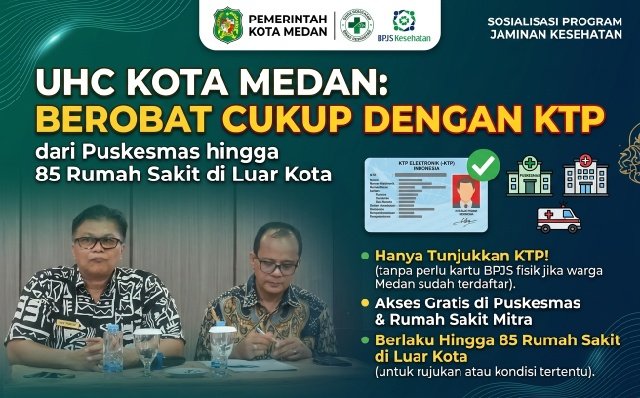
- UHC Kota Medan: Berobat Cukup dengan KTP, dari Puskesmas hingga 85 Rumah Sakit di Luar Kota
- Perubahan Besar: Dari Bantuan Terbatas ke Perlindungan Universal
- Syarat KTP: Domisili Medan Minimal Tiga Bulan
- Dua Pintu Layanan: Puskesmas dan IGD Rumah Sakit
- Kelas III untuk Semua: Tidak Dibedakan Status Ekonomi
- Tunggakan BPJS Kesehatan Tidak Otomatis Diputihkan
- Identitas Keluarga Sering Menjadi Kendala
- 75.435 Pelayanan Kesehatan Telah Diberikan
- 85 Rumah Sakit di Luar Medan Layani Warga
- Fast Response: Koordinasi 24 Jam Lintas Sektor
- Warga Tanpa Identitas: Layanan via Program Unregister
UHC Kota Medan: Berobat Cukup dengan KTP, dari Puskesmas hingga 85 Rumah Sakit di Luar Kota
Bayangkan sakit di perantauan, jauh dari kampung halaman, dan tetap bisa berobat gratis hanya dengan menunjukkan KTP Medan. Itulah kenyataan yang kini dinikmati warga Kota Medan melalui program Universal Health Coverage (UHC) yang telah berjalan sejak 1 Desember 2022.
Melalui skema perlindungan sosial ini, warga yang belum memiliki BPJS Kesehatan maupun peserta yang kepesertaan tidak aktif dapat memperoleh akses pelayanan kesehatan dengan menggunakan KTP, sesuai ketentuan yang berlaku. Bukan hanya di Medan—layanan ini bahkan menjangkau 85 rumah sakit di luar kota, hingga Jakarta, Tangerang, Bogor, dan Surabaya.
Perubahan Besar: Dari Bantuan Terbatas ke Perlindungan Universal
PIC UHC Jaminan Kesehatan Medan Bertuah (JKMB) Dinas Kesehatan Kota Medan, Salmon Sembiring Brahmana, menjelaskan bahwa penerapan UHC merupakan perubahan pendekatan pemerintah dalam menjamin akses kesehatan masyarakat.
Sebelumnya, bantuan jaminan kesehatan lebih banyak diarahkan kepada masyarakat yang masuk kategori miskin dan tidak mampu. Kini, melalui UHC, perlindungan diperluas agar tidak ada warga yang kehilangan akses layanan kesehatan hanya karena persoalan biaya.
Syarat KTP: Domisili Medan Minimal Tiga Bulan
Identitas kependudukan menjadi persyaratan mutlak bagi warga yang ingin mendapatkan pelayanan melalui UHC Kota Medan. Warga harus memiliki KTP dengan domisili Kota Medan dan telah menjadi penduduk setempat sekurang-kurangnya tiga bulan.
Persyaratan tersebut diberlakukan setelah pemerintah melakukan evaluasi terhadap pelaksanaan awal program pada 2022. Salmon mengungkapkan, ketika program pertama kali diluncurkan, pendaftaran melalui aplikasi sempat membuka peluang warga dari luar daerah mendaftarkan diri sebagai penduduk Kota Medan untuk memperoleh pembiayaan kesehatan.
Kondisi itu dikhawatirkan menambah beban pemerintah daerah, sementara warga Kota Medan yang telah lama berdomisili justru harus tetap mendapatkan jaminan pelayanan. Karena itu, Dinas Kesehatan bersama BPJS Kesehatan dan organisasi perangkat daerah terkait melakukan penyesuaian mekanisme pendaftaran.
Kebijakan tersebut kemudian diperkuat dengan adanya dukungan pemerintah provinsi pada Oktober 2025, sehingga persoalan pembiayaan bagi masyarakat yang membutuhkan jaminan kesehatan dapat ditangani melalui koordinasi lintas pemerintahan.
Dua Pintu Layanan: Puskesmas dan IGD Rumah Sakit
Dalam mekanisme pelayanan, warga yang menggunakan UHC melalui KTP pada prinsipnya mengakses layanan dari dua pintu: puskesmas dan instalasi gawat darurat (IGD) rumah sakit.
Untuk pelayanan non-darurat, warga terlebih dahulu mendatangi puskesmas. Apabila berdasarkan pemeriksaan dokter terdapat indikasi medis yang membutuhkan penanganan lanjutan, pasien akan mendapatkan rujukan ke rumah sakit.
Untuk kondisi kegawatdaruratan, pasien dapat langsung mendatangi IGD rumah sakit tanpa harus menunggu proses rujukan dari puskesmas.
Salmon menegaskan, mekanisme tersebut dibuat untuk memastikan pelayanan kesehatan berjalan sesuai kebutuhan medis pasien. Ia juga mengingatkan bahwa tidak semua penyakit harus mendapatkan rujukan ke rumah sakit. Terdapat 144 jenis penyakit yang pada prinsipnya dapat ditangani di fasilitas pelayanan kesehatan tingkat pertama sesuai kompetensi dokter umum.
“Jadi, masyarakat diharapkan memahami fungsi puskesmas sebagai fasilitas pelayanan kesehatan pertama, bukan langsung menganggap rumah sakit sebagai satu-satunya tempat untuk mendapatkan pengobatan,” pesannya.
Kelas III untuk Semua: Tidak Dibedakan Status Ekonomi
Pelayanan melalui skema UHC dengan KTP diberikan pada pelayanan kelas III. Warga yang memiliki kemampuan ekonomi lebih baik tetap dapat memanfaatkan program tersebut sepanjang mengikuti ketentuan kelas pelayanan yang ditetapkan.
“Seluruh penduduk sama. Mau kelas satu, kelas dua, kelas tiga, yang penting untuk UHC ini pelayanan yang ditanggung adalah kelas tiga. Tidak dibedakan orang yang punya mobil empat atau Fortuner, yang penting memenuhi persyaratan,” jelas Salmon.
Tunggakan BPJS Kesehatan Tidak Otomatis Diputihkan
Salmon turut mengingatkan masyarakat yang memiliki tunggakan iuran BPJS Kesehatan agar memahami konsekuensi ketika beralih menggunakan pembiayaan pemerintah melalui UHC.
Ketika peserta mandiri dengan tunggakan kemudian didaftarkan sebagai peserta yang iurannya ditanggung pemerintah, tunggakan sebelumnya tidak otomatis diputihkan. Tunggakan tersebut tetap tercatat dalam sistem BPJS Kesehatan.
Apabila suatu saat peserta ingin kembali menjadi peserta mandiri dengan kelas pelayanan yang lebih tinggi, kewajiban tunggakan tersebut dapat kembali menjadi persoalan yang harus diselesaikan.
Namun, ia menjelaskan bahwa perhitungan tunggakan iuran yang harus dibayarkan untuk mengaktifkan kembali kepesertaan mandiri dibatasi maksimal 24 bulan atau dua tahun. Peserta yang memiliki tunggakan selama enam tahun, misalnya, tidak serta-merta harus membayar seluruh tunggakan enam tahun—perhitungan kewajiban tersebut dibatasi maksimal 24 bulan sesuai ketentuan BPJS Kesehatan.
Selain itu, terdapat denda pelayanan bagi peserta yang memiliki tunggakan dan kemudian memanfaatkan pelayanan rawat inap dalam kondisi tertentu setelah kepesertaannya diaktifkan kembali. Denda dihitung sebesar 5 persen dari biaya pelayanan kesehatan berdasarkan ketentuan yang berlaku.
Identitas Keluarga Sering Menjadi Kendala
Dalam praktik pelayanan, persoalan administrasi kependudukan masih menjadi salah satu kendala yang kerap ditemui Dinas Kesehatan. Salmon menyebutkan, permasalahan yang sering muncul antara lain NIK ganda, data kependudukan tidak sesuai, hingga anggota keluarga yang belum tercatat dalam kartu keluarga.
Salah satu kasus yang kerap terjadi adalah anak yang baru lahir belum dimasukkan ke dalam kartu keluarga. Ada pula keluarga yang belum memperbarui susunan kartu keluarga setelah menikah, sehingga anak atau anggota keluarga masih tercatat dalam administrasi keluarga sebelumnya.
Akibatnya, ketika membutuhkan pelayanan kesehatan, data pasien tidak dapat langsung dicocokkan dengan sistem kependudukan dan BPJS Kesehatan.
“Jadi, jangan sampai anak kita membutuhkan pelayanan kesehatan, tetapi identitasnya belum ada. Ini menjadi tanggung jawab bersama. Solusinya, segera urus kartu keluarga,” ujarnya.
75.435 Pelayanan Kesehatan Telah Diberikan
Sejak pelaksanaan UHC dimulai pada 1 Desember 2022 hingga 2 September 2026, program tersebut telah dimanfaatkan masyarakat untuk mengakses pelayanan di berbagai fasilitas kesehatan yang bekerja sama dengan BPJS Kesehatan.
- Pelayanan melalui puskesmas dengan indikasi rujukan 21.684
- Pelayanan langsung melalui IGD rumah sakit 53.751
- Total pelayanan tercatat ±75.435
- Peserta terdaftar melalui pembiayaan Pemko Medan 216.854
Salmon menjelaskan, pembiayaan UHC tidak hanya diperuntukkan bagi warga yang sedang sakit. Ketika seseorang didaftarkan sebagai peserta yang iurannya ditanggung pemerintah, kewajiban pembiayaan kepesertaannya tetap berjalan meskipun yang bersangkutan belum pernah menggunakan pelayanan kesehatan.
“BPJS ini sistemnya sosial. Sepanjang kita membantu orang yang sehat untuk menolong orang yang sakit, itu memang prinsipnya. Jadi, tidak bisa hanya orang yang sakit saja yang didaftarkan,” katanya.
Konsekuensinya, kebutuhan anggaran Pemerintah Kota Medan untuk membiayai program tersebut terus meningkat. Pada 2022, anggaran yang dibutuhkan sekitar Rp96 miliar. Sementara pada 2026, pembiayaannya telah mendekati Rp300 miliar. Kenaikan tersebut sejalan dengan perluasan kepesertaan dan kewajiban pemerintah daerah membayarkan iuran peserta yang menjadi tanggung jawabnya.
85 Rumah Sakit di Luar Medan Layani Warga
Jangkauan pelayanan UHC Kota Medan juga tidak terbatas pada fasilitas kesehatan yang berada di wilayah administrasi kota. Salmon mengungkapkan, terdapat 85 rumah sakit di luar Kota Medan yang telah melayani warga Kota Medan melalui skema UHC dengan KTP.
Jangkauan pelayanan tersebut bahkan telah mencapai sejumlah wilayah di Pulau Jawa, di antaranya Jakarta, Tangerang, Bogor, hingga Surabaya. Hal tersebut menunjukkan bahwa warga Kota Medan tetap dapat mengakses pelayanan kesehatan ketika berada di luar daerah, sepanjang rumah sakit yang dituju telah bekerja sama dan memenuhi ketentuan pelayanan program.
Fast Response: Koordinasi 24 Jam Lintas Sektor
Untuk mempercepat penanganan persoalan kepesertaan, Dinas Kesehatan membangun koordinasi lintas sektor melalui wadah komunikasi yang disebut Fast Response. Wadah tersebut melibatkan direktur rumah sakit, unsur BPJS Kesehatan, Dinas Sosial, Dinas Kesehatan, Dinas Kependudukan dan Pencatatan Sipil (Disdukcapil), serta kepala puskesmas.
Melalui koordinasi tersebut, persoalan pelayanan kesehatan masyarakat dapat ditangani selama 24 jam. Koordinasi dilakukan secara intensif karena proses pengaktifan kepesertaan membutuhkan ketepatan waktu—keterlambatan administrasi berpotensi membuat pasien tidak dapat segera memperoleh persetujuan pelayanan.
Pihaknya bersama Disdukcapil dan instansi terkait juga terus melakukan pemadanan data peserta secara berkala untuk memastikan data peserta sesuai dengan kondisi kependudukan terbaru, termasuk apabila terdapat peserta yang sudah meninggal dunia atau pindah domisili.
Warga Tanpa Identitas: Layanan via Program Unregister
Selain warga yang belum memiliki BPJS Kesehatan dan peserta yang tidak aktif, Dinas Kesehatan Kota Medan juga menghadapi persoalan masyarakat yang tidak memiliki identitas kependudukan. Untuk kondisi tersebut, terdapat mekanisme pelayanan melalui program unregister bagi warga yang berasal dari daerah lain atau belum memiliki identitas—nantinya akan dicocokkan dengan retina mata agar diketahui warga mana.
Pemerintah daerah kini semakin memperkuat koordinasi agar tanggung jawab pembiayaan kesehatan dapat disesuaikan dengan asal daerah pasien. Misalnya, apabila pasien diketahui berasal dari Kabupaten Karo, koordinasi dapat dilakukan dengan pemerintah Kabupaten Karo. Begitu pula apabila pasien berasal dari Pematangsiantar.
Sementara untuk masyarakat tanpa identitas yang membutuhkan pertolongan, Dinas Kesehatan telah menetapkan mekanisme pelayanan melalui tiga rumah sakit:
1. RSUD H Bachtiar Djafar
2. RSUD dr Pirngadi Medan
3. UPTD RSJ Prof Ildrem
“Melayani dengan Hati”
Bagi Salmon, capaian UHC bukan sekadar angka kepesertaan yang melampaui jumlah penduduk. Ukuran keberhasilannya juga terletak pada kemampuan pemerintah memastikan masyarakat memperoleh pelayanan ketika benar-benar membutuhkan pertolongan.
“Ini bagian dari pelayanan kita. Kita harus melayani dengan hati. Ada risiko yang harus kita kerjakan, tetapi ini merupakan bagian dari tanggung jawab kita sebagai pelayan masyarakat,” ujarnya.
Medan telah membuktikan: kesehatan adalah hak semua orang—bukan kemewahan bagi yang mampu. ***obs
Tag: UHC Kota Medan, Jaminan Kesehatan Medan Bertuah (JKMB), BPJS Kesehatan Medan, berobat dengan KTP Medan, layanan kesehatan gratis Medan, syarat UHC Kota Medan domisili tiga bulan, alur layanan UHC puskesmas dan IGD, 144 penyakit ditangani puskesmas, kelas III layanan UHC Medan, tunggakan BPJS tidak diputihkan UHC, denda pelayanan BPJS 5 persen, 85 rumah sakit luar Medan layani UHC, Fast Response Dinkes Medan, program unregister tanpa identitas, anggaran UHC Medan Rp300 miliar, cara berobat gratis di Medan hanya dengan KTP, persyaratan KTP domisili Kota Medan untuk UHC, mekanisme rujukan puskesmas ke rumah sakit UHC Medan, penyebab kepesertaan BPJS tidak aktif dan solusinya, NIK ganda dan kartu keluarga jadi kendala layanan UHC, rumah sakit di Jakarta dan Surabaya layani warga Medan, tiga rumah sakit untuk pasien tanpa identitas di Medan, perhitungan tunggakan BPJS maksimal 24 bulan, dampak UHC terhadap anggaran Pemko Medan 2026
Hashtag: #UHCMedan #JaminanKesehatanMedan #BPJSKesehatan #MedanBertuah #BerobatDenganKTP #UniversalHealthCoverage #UHCIndonesia #PemkoMedan #DinkesMedan #JKN #JKMB #LayananKesehatanPublik #Medan #KotaMedan #SumateraUtara #InfoMedan #BeritaMedan #KesehatanGratis #SehatBersama #LayananPublik #KTPJadiBPJS #PuskesmasMedan #IGDRumahSakit #KelasIIIBPJS #FastResponseDinkesMedan #UnregisterBPJS #RujukanPuskesmas #144Penyakit #KesehatanUntukSemua #TidakAdaYangTertinggal #MelayaniDenganHati #MedanSehat #IndonesiaSehat #SehatTanpaTakutMiskin #HakSehatSemuaWarga