
Editor’s note
- The three biggest risks when investing in stocks and smart ways to avoid them
- Price fluctuations: don’t panic if you see red
- Liquidity risk: when you want to sell but there are no buyers
- Company performance: the most fundamental risk
- How to protect yourself against stock risks
The three biggest risks when investing in stocks and smart ways to avoid them
Many people are drawn to the stock market because they often hear stories about huge profits and the possibility of getting rich in the long run. Many view stocks as the path to financial freedom.
Stocks do indeed have extraordinary growth potential. However, behind these great opportunities always lie risks that one must understand.
LATEST NEWS: Prabowo’s ‘one-stop export policy’ receives support from the business community. What impact will this have on Indonesia?
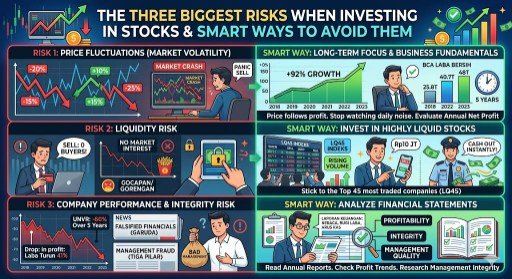
Successful investors are not those who consistently make profits, but those who understand risks and can manage them well. In the stock market, there are three key risks to consider: price fluctuations, liquidity risk, and risks related to company performance.
Price fluctuations: don’t panic if you see red
For novice investors, the daily price movements of stocks often feel like a rollercoaster ride. Today the price rises, tomorrow it falls, and the day after that it rises again. This situation often leads to emotional turmoil.
Imagine that you bought Bank Central Asia (BCA) shares five days ago. When you open your investment app, you see that the price has dropped by 2.7%. Your portfolio is in the red. Many novice investors immediately panic and think that stocks are not the right investment instrument for them.
But if we look at the bigger picture, the story can be very different. Over a period of five years, BCA shares once rose by no less than 92%. Where did such a significant increase come from? The answer is simple: the company’s profit growth.
LATEST NEWS: 5 signs of a mild stroke that often go unnoticed, but be alerted in time
In 2018, BCA’s net profit amounted to approximately 25.8 trillion Indonesian rupees. A few years later, that profit had risen to about 40.7 trillion Indonesian rupees, and it was even expected to approach 48 trillion Indonesian rupees. When a company’s profits rise dramatically, it is logical that the share price will rise as well.
This is an important lesson that investors often forget. In the long term, share prices follow the direction of the company’s profit growth. Companies need time to develop. It is unfair to judge the quality of a company solely based on price movements over a few days.
Therefore, it is better to focus on the company’s annual performance development rather than worrying about tracking prices hourly. Patient investors often achieve much better results than those who are too busy chasing daily fluctuations.
LATEST NEWS: Strategy to earn 20 million rupiah per month without working
Liquidity risk: When you want to sell, but there are no buyers
A second risk that is often overlooked is liquidity. Imagine that one day you need money quickly and want to sell your shares. However, it turns out that there are no buyers willing to purchase the shares. As a result, your money is tied up.
This risk is called liquidity risk. To understand the importance of liquidity, you can compare stocks to real estate. Selling a house for 1 billion rupiah can take months. It requires finding buyers, conducting appraisals, negotiating the price, processing documents, and even lengthy notarial procedures.
Liquid stocks, on the other hand, can be sold with a few taps on a phone screen. Under normal circumstances, transactions can take place within seconds. However, this convenience only applies if the stocks you own are in high demand.
Therefore, novice investors should avoid stocks that are rarely traded, often referred to as ‘sold stocks’. These stocks usually have a thin line between buyers and sellers, making them difficult to liquidate when necessary.
LATEST NEWS: The Rupiah breaks the 18,000 rupiah barrier in offshore markets, a dangerous signal that must not be ignored
A simple way to reduce liquidity risk is to focus on stocks included in the LQ45 index. This index contains companies with high liquidity and high daily trading activity. This way, you do not have to worry about your money getting stuck in assets that are difficult to sell.
Company Performance: The Most Fundamental Risk
The third and most important risk is the company’s performance. For example, many people were surprised by the significant drop in Unilever Indonesia’s share price in recent years. This is despite the fact that the company is known as one of the largest and most established companies in Indonesia.
Upon closer examination, it appears that the primary cause was a decline in the company’s profits. Net profit, which was previously high, fell significantly in subsequent years.
The market reacted fairly to these circumstances. When profits fell, stock prices fell as well. This phenomenon confirms an important principle in investing: stock prices ultimately follow the direction of company performance.
LATEST NEWS: Get ready for the storm of 2030!
However, risks to company performance do not stem solely from declining revenue or competition. There are other, much more dangerous threats: issues with management integrity.
The history of the Indonesian capital market includes several cases that offer important lessons for investors. Some companies were involved in the manipulation of financial statements, while others were guilty of unethical business practices. When management integrity is called into question, financial statements become difficult to trust.
If financial statements are no longer credible, investors lose their most important compass for assessing the health of the company. Under such circumstances, the risk of loss and even bankruptcy becomes much greater.
How to protect yourself against stock risks
To mitigate these risks, investors can take three simple steps.
LATEST NEWS: Ministry of Labor and Huawei Indonesia strengthen cooperation on personnel development and internship programs
First, avoid cheap stocks that lack clear fundamentals and are often the subject of speculation. Secondly, focus on liquid stocks that are easy to buy and sell when needed. Stocks in the LQ45 index can be a safer first choice for beginners.
Thirdly, and most importantly, learn to read financial reports. Do not rely solely on recommendations from influencers, social media groups, or market rumors.
Financial reports provide the most honest picture of a company’s true situation. Based on these, investors can see whether the company is profitable, has a healthy debt burden, and is capable of sustainable growth.
Ultimately, investing in stocks is not a game of chance or simply following your gut feeling. Stock investing is the art of risk management using knowledge and skills. The better we understand risk, the greater our chance of an optimal long-term investment return. ***tok