Editor’s Note
- The Struggle of Prosecutors and State Lawyers Ignored by the State
- The Prosecutor’s Powers in Prosecution
- Prosecutors as Case Managers
- Prosecutors work with complete dedication and without boundaries
- Strong prosecutors cannot complain
The Struggle of Prosecutors and State Lawyers Ignored by the State
The Public Prosecution Service is a government institution whose functions are related to the judiciary, and it exercises the state’s prosecutorial powers and other statutory powers (see Article 1, Section 1, of Law No. 16 of 2004 on the Public Prosecution Service of the Republic of Indonesia, as amended by Law No. 11 of 2021 on Amendments to Law No. 16 of 2004 on the Public Prosecution Service of the Republic of Indonesia/Public Prosecution Service Act).
According to this definition, the Public Prosecution Service, through its prosecutors, is the only government institution that is related to the judiciary’s prosecutorial powers and exercises them independently.
The Prosecutor’s Powers in Prosecution
The prosecutor’s powers in prosecution cannot be interpreted narrowly, as the performance of prosecutorial duties encompasses a broad and strategic scope, from the initiation of an investigation to the resolution of a criminal case.
Furthermore, prosecutors can also act as investigators, prosecutors, and even as executors in special criminal cases.
Furthermore, prosecutors also have duties in civil law and state administration, representing the state both in and out of court as state advocates.
Given all the powers inherent in prosecutors, they can be said to be defenders of the state, acting not only as prosecutors in the criminal justice system but also as state advocates, fulfilling all these roles to promote the state’s interests both in and out of court.
Prosecutors as Case Managers
In the criminal justice system, prosecutors are called case managers (dominus litis), who ensure that a criminal case can be referred to the court.
This task cannot be interpreted narrowly, as prosecutors are involved in monitoring a case from the outset of the investigation to ensure it can go to trial.
In short, the prosecutor’s duties in the criminal justice system include preparing for the prosecution, the prosecution itself, the trial, and the execution of a binding court ruling.
The strategic authority inherent in prosecutors makes them key players in the criminal justice system. They represent the power of the state in the prosecution process and actively handle a case from start to finish.
Prosecutors work with complete dedication and without boundaries
In carrying out these duties, prosecutors work with complete dedication and without boundaries, as embodied in the values of Tri Krama Adhyaksa (Prosecutor’s Authority), which are inherent to every prosecutor as Insan Adhyaksa (Prosecutor’s Authority).
Prosecutors are located throughout Indonesia and carry out their duties to uphold the law and achieve justice in Indonesia.
In carrying out their duties, prosecutors must be prepared to be stationed anywhere in Indonesia.
Prosecutors cannot choose where they are stationed, so they cannot refuse any assignment.
When stationed in major cities, prosecutors face numerous complex cases that must be handled with varying degrees of difficulty.
When stationed in remote areas of the country, prosecutors must be prepared to leave their families and homes far away.
There is no preferential treatment for prosecutors, regardless of their location, as every prosecutor has the same duty: to uphold the law and ensure justice throughout Indonesia.
Even in the fight against corruption, prosecutors are invariably present in remote areas.
Prosecutors not only handle major corruption cases with financial losses to the state running into trillions of rupiah, but they are also present to handle corruption cases nationwide, with the aim of eradicating corruption and preventing and recovering financial losses to the state.
Although the state is present to represent its interests, with a broad remit and an unlimited scope of law enforcement, it has failed to provide for the well-being of every prosecutor across the archipelago, who are the primary driving force behind the criminal justice system.
The welfare problem is a classic one, as the state is unable to be present in the lives of every public prosecutor to support the performance of their duties throughout Indonesia.
The heavy demands placed on public prosecutors, regardless of time and region, in carrying out their duties are not accompanied by the welfare the state should offer as a token of appreciation for every public prosecutor who works for the state, both inside and outside the court.
Although the state is currently absent and neglecting the well-being of its prosecutors, this is no excuse for prosecutors to neglect their duties.
Strong prosecutors cannot complain
Prosecutors continue to fight despite the limitations and income inequality they face, because every prosecutor remains committed to and adheres to the values enshrined in the Tri Krama Adhyaksa (Tri Krama Adhyaksa).
It is inconceivable that the state’s absence from the well-being of prosecutors would lead to their absence from carrying out their duties, especially in criminal law. The Indonesian judicial system would cease to function, as prosecutors are the primary driving forces overseeing the handling of cases from start to finish.
Despite the welfare challenges facing every prosecutor today, prosecutors remain the champions of the state, both inside and outside the courtroom, for the benefit of the Indonesian state.
Prosecutors are resilient warriors who must never complain or give up in carrying out their duties for the state, even if the state is currently absent from their welfare.
Currently, prosecutors are willing to sacrifice their own welfare to carry out their various duties for the state, both inside and outside the courtroom, and to uphold the law and achieve justice in Indonesia. ***
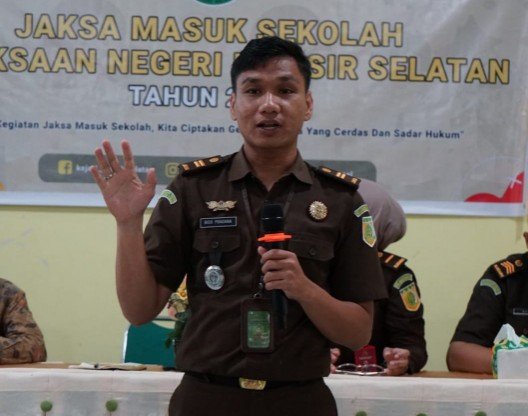
Rido Pradana, S.H., M.H.
The author is a public prosecutor and head of the Intelligence Department of the Pesisir Selatan Public Prosecutor’s Office