
Editor’s Note
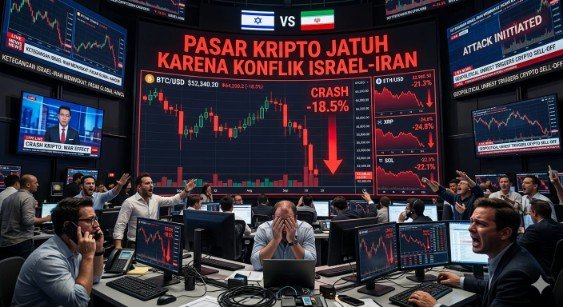
- Since the outbreak of the war, crypto wallets have been in the red: Sell or buy?
- The Bitcoin Price Drop
- Focus on the data
- Four steps to deal with the Bitcoin situation
Since the outbreak of the war, crypto wallets have been in the red: Sell or buy?
The war broke out and crypto plummeted. The first reaction would be to sell everything, right? But wait, is that really the right decision? Or is it time to buy?
Since the outbreak of the war, crypto wallets have been in the red and plummeting. Your brain immediately screams: “Sell everything now!” But are you sure that is the right move?
The Bitcoin Price Drop
Let’s first take a look at what actually happened in those dramatic and panic-inducing first minutes.
Take the recent crisis between Iran and Israel, for example. The Bitcoin price immediately plummeted by 6%. That is enough to make you nervous, right? What is even worse is that the 6% drop occurred in just 45 minutes. This triggered a massive panic in the derivatives market. As a result, leveraged positions worth $515 million were wiped out and forced liquidation in the blink of an eye.
This was the main cause of the sharp price drop. It seemed as if the market was cleansing itself of speculators.
Does this initial panic really reflect everything? If we look at historical data, the story is quite different. The pattern is very consistent. Whether it concerns the Russian invasion of Ukraine or an attack from Iran, the pattern is almost always the same.
Initially, the price drops sharply, but then recovers very quickly. In fact, in the subsequent 30 to 50 days, performance is even positive.
Look, when the incident between Russia and Ukraine took place, the price dropped by 9%, but a month later it rose by 27%. This chart explains the previous table in a simpler way. Look at the red line representing the initial panic. It is only a small difference, isn’t it, compared to the green bar showing the subsequent rise?
This is strong evidence that panic selling is often the wrong move. But wait, not all news is equally reliable. There are two pitfalls to watch out for: news about crypto ransom payments and news about truces.
This quote is crucial. Essentially, the market isn’t really afraid that crypto is being used by criminals. What they fear most is governments demonstrating that they can intervene and seize those crypto assets.
That is what is dangerous for the mainstream crypto narrative. The most obvious example is the Colonial Pipeline case. Step one: the ransom of 75 Bitcoin was paid.
Step two: the FBI seized the private key. And therein lies the problem. Step three: the price immediately plummeted by 10%. Why? Because the narrative that crypto is untouchable by governments immediately fell apart. The second pitfall is the ceasefire. There is a very well-known principle in the market: buy the rumor, sell the news. What does that mean?
Big investors, or ‘smart investors’, start buying during critical moments, while the rumors are still unclear. As soon as there is good news, such as an official ceasefire, and everyone becomes optimistic, they sell to make a profit.
Focus on the data
How can we avoid getting carried away by emotions and dramatic news like that? The answer is simple: focus on the data, not on the drama of the headlines.
The first reliable indicator is the RSI. During the crisis in Iran, everyone was selling in a panic, right? Do you know what Bitcoin’s RSI was back then? 16. This is an extremely oversold signal.
History shows that when the RSI is this low, it is time to buy, not to sell. There are two other important data points to keep an eye on. First, the inflow into ETF funds.
Simply put: just look at what major institutions are doing. During the conflict in Iran, they were still buying $1.1 billion. This means they still believe in the market.
Second, oil prices. If oil prices rise, inflation can increase, which can put pressure on risky assets like crypto.
Four steps to deal with the Bitcoin situation
Let’s now summarize this into one smart strategy that you can apply immediately. The conclusion is therefore: a four-step plan to deal with such a situation.
First, do not panic if a war breaks out. Monitor the RSI and be ready to buy after 2-3 days. Second, be cautious if there is news about ransom being paid in crypto and subsequently seized by the government; this could be a bad sign.
Thirdly, as soon as a ceasefire is declared, implement a selling strategy based on good news. If you have already made a profit, do not be greedy; take your profits. And finally, fourthly, always confirm all your decisions with macroeconomic data.
Check oil prices and ETF cash flows. That is a data-driven plan. But the market is always full of surprises, isn’t it?
Of the four strategies mentioned above, which one do you agree with the most? Or perhaps you have a secret trick of your own. ***tok