North Sumatra expands access to digital services—here’s how it works!
The North Sumatra (Sumut) Provincial Communication and Informatics Office (Kominfo) is encouraging district governments to update and ensure the accuracy of data regarding “blind spots” (areas without coverage) in their respective regions.
This updating process is crucial to ensure that the development of telecommunications and internet infrastructure can be targeted at the areas that truly need it.
LATEST NEWS: Indonesian Skills Competition (Inaskill) 2026: Efforts to Train Competent Mobile Phone Technicians
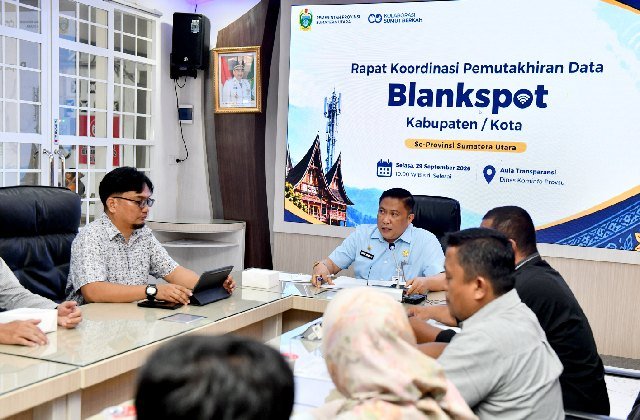
This was announced by the Head of the North Sumatra Kominfo Office, Erwin Hotmansah Harahap, during a coordination meeting on updating blind spot data for districts and cities across North Sumatra, held at the Transparency Hall of the North Sumatra Kominfo Office on Tuesday, September 29, 2026.
“There are still areas that actually have signal coverage but are classified as blind spots. Conversely, truly isolated areas are being overlooked in development plans. That is why we need accurate data,” said Erwin.
Erwin noted that several areas in North Sumatra still lack optimal telecommunications and internet signal coverage. This situation can hinder citizens’ access to various public services and slow down the equitable distribution of digital transformation across the regions.
According to Erwin, data inaccuracies can result in infrastructure development failing to achieve its intended goals. Therefore, accurate and up-to-date spatial data is essential as a basis for proposing telecommunications and internet infrastructure development.
LATEST NEWS: Changing your financial mindset: 5 sources of extra income you rarely discover
“Accurate, real-time spatial data form the basis for proposing the development of telecommunications and internet infrastructure,” said Erwin.
For this reason, the North Sumatra provincial government (Pemprov)—through the North Sumatra Communication and Information Agency—is working to update data using the ‘Blankspot North Sumatra’ platform.
This data serves not only as a foundation for infrastructure development proposals but also supports the acceleration of digital transformation and strengthens coordination between provincial and district/municipal governments.
“This data update also aims to accelerate digital transformation in North Sumatra and improve coordination between provincial and district/municipal governments,” Erwin stated.
He explained that coverage gaps—or “blind spots”—are categorized into two types: total blind spots and partial blind spots. Total blind spots are areas with no mobile signal—whether in residential areas or public buildings—while partial blind spots are areas where a signal exists at certain points but is unstable or limited to voice and SMS services.
During the update process, district and municipal administrations must appoint a technical team responsible for data entry.
The submitted data must be complete, accurate, and backed by valid documentation so that it can be verified and used as a basis for development planning.
“The provincial government will continue to monitor the progress of data entry in real time via the SIGAP dashboard,” said Erwin.
LATEST NEWS: Bobby Nasution discusses accelerating subsidized housing construction with House of Representatives representatives
With this update, the North Sumatra provincial government hopes to more accurately map the regional disparities in telecommunications and internet access.
With reliable data, the development of digital infrastructure is expected to proceed in a more targeted manner, ensuring that people in underserved areas gain more equitable access to communication and information services. ***rel
Sumatera Utara Perluas Akses Layanan Digital, Begini Langkahnya!
Dinas Komunikasi dan Informatika (Kominfo) Provinsi Sumatera Utara (Sumut) mendorong Pemerintah Kabupaten/Kota memperbarui dan memastikan akurasi data blankspot di wilayah masing-masing.
Pemutakhiran tersebut penting agar pembangunan infrastruktur telekomunikasi dan internet dapat diarahkan ke wilayah yang benar-benar membutuhkan.
Hal tersebut disampaikan Kepala Dinas Kominfo Sumut Erwin Hotmansah Harahap saat Rapat Koordinasi Pemutakhiran Data Blankspot Kabupaten/Kota se-Sumut di Aula Transparansi, Kantor Dinas Kominfo Sumut, Selasa, 29 September 2026.
“Masih ada wilayah yang sebenarnya sudah terjangkau sinyal, tetapi tercatat sebagai blankspot. Sebaliknya, wilayah yang benar-benar terisolasi justru luput dari usulan pembangunan. Itu sebabnya kami butuh data yang akurat,” kata Erwin.
Erwin mengatakan, masih terdapat sejumlah wilayah di Sumut yang belum terjangkau sinyal telekomunikasi dan internet secara optimal. Kondisi tersebut dapat menghambat masyarakat dalam mengakses berbagai layanan publik serta memperlambat pemerataan transformasi digital di daerah.
Menurut Erwin, ketidakakuratan data dapat menyebabkan pembangunan infrastruktur tidak tepat sasaran. Karena itu, data spasial yang akurat dan mutakhir diperlukan sebagai dasar dalam mengusulkan pembangunan infrastruktur telekomunikasi dan internet.
“Data spasial yang akurat dan real-time ini menjadi dasar pengusulan Pembangunan infrastruktur telekomunikasi dan Internet,” kata Erwin.
Untuk itu, Pemerintah Provinsi (Pemprov) Sumut melalui Dinas Kominfo Sumut melakukan pemutakhiran data menggunakan platform Blankspot Sumut.
Data tersebut tidak hanya menjadi dasar pengusulan pembangunan infrastruktur, tetapi juga mendukung percepatan transformasi digital serta memperkuat koordinasi antara pemerintah provinsi dan kabupaten/kota.
“Pemutakhiran data ini juga untuk percepatan transformasi digital di Sumut, juga untuk koordinasi koordinasi antara pemerintah provinsi dan kabupaten/kota,” ujar Erwin.
Ia menjelaskan, blankspot terbagi menjadi dua kategori, yakni blankspot penuh dan blankspot parsial. Blankspot penuh merupakan wilayah yang sama sekali tidak memiliki sinyal seluler, baik di kawasan pemukiman maupun fasilitas publik, sedangkan blankspot parsial merupakan wilayah yang memiliki sinyal pada titik tertentu, tetapi tidak stabil atau hanya terbatas pada layanan suara dan SMS.
Dalam proses pemutakhiran tersebut, pemerintah kabupaten/kota diminta menunjuk tim teknis yang bertanggung jawab terhadap pengisian data. Data yang disampaikan harus lengkap, akurat, serta dilengkapi bukti dokumentasi yang valid sehingga dapat diverifikasi dan menjadi dasar perencanaan pembangunan.
“Pemerintah Provinsi akan terus memantau progres pengisian data melalui dashboard SIGAP secara real-time,” kata Erwin.
Melalui pemutakhiran tersebut, Pemprov Sumut berharap kesenjangan akses telekomunikasi dan internet antardaerah dapat dipetakan secara lebih tepat.
Dengan data yang valid, pembangunan infrastruktur digital diharapkan semakin terarah sehingga masyarakat di wilayah yang belum terlayani dapat memperoleh akses layanan komunikasi dan informasi secara lebih merata. ***rel