
Ministry of Labor Boosts Economic Independence in Disaster-Stricken Areas Through Vocational Training
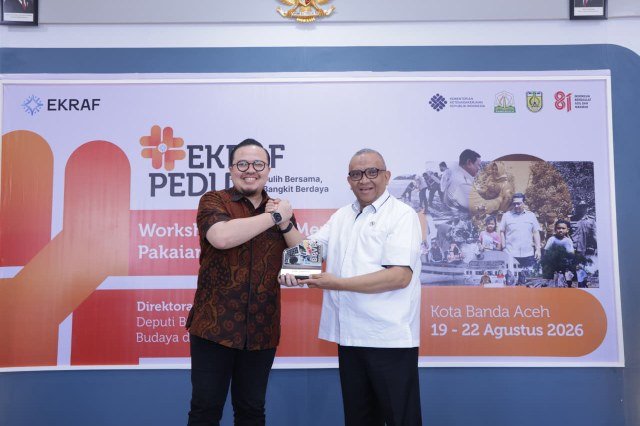
The Ministry of Labor (Kemnaker), through the Vocational and Productivity Training Center (BPVP) in Banda Aceh, organized a technical workshop on garment manufacturing to accelerate post-disaster reconstruction and recovery in Banda Aceh, Sumatra.
The event was a collaboration between the Ministry of Labor and the Ministry of Creative Economy. The Ministry of Labor initiated the workshop, while BPVP Banda Aceh served as one of the implementation sites and provided technical support through vocational training.
Deputy Minister of Labor Afriansyah Noor stated that post-disaster recovery must consider not only the rebuilding of infrastructure and the environment but also community capacity.
“Disasters affect not only infrastructure and the environment but can also disrupt economic activity, livelihoods, local businesses, and labor productivity,” Afriansyah said.
According to him, garment sewing skills are relevant to the development of the creative economy, as they enable the creation of value-added products and generate business opportunities for the community.
Afriansyah commended the collaboration between the various ministries involved in this activity. He believed that post-disaster reconstruction requires the involvement of diverse parties to link training with the region’s economic potential.
LATEST NEWS: North Sumatra Provincial Government Strengthens Universal Health Coverage in West Nias Through Collaboration
Afriansyah sees great potential for Aceh in the fashion sector, citing its rich culture, motifs, craftsmanship, community creativity, and local identity—all of which can be developed into products for the creative economy.
“This potential must be accompanied by an increase in competence. We cannot simply produce good products; we must also be able to produce goods that are of high quality, feature attractive designs, are trendy, possess a distinct identity, are competitively priced, and are acceptable to consumers,” he said.
He added that training programs must align skills with the sector’s actual needs, covering everything from the production process to the ability to develop and market products.
LATEST NEWS: Governor Bobby Nasution Discusses Strengthening the Status of Inmates and Combating Drugs
This approach allows the skills acquired by participants to be translated into economic activities.
“From skills to products, from products to businesses, from businesses to income, and from income to economic independence. This is the vocational mindset we must continue to foster,” Afriansyah stated. ***REL
1 komentar