Editor’s note
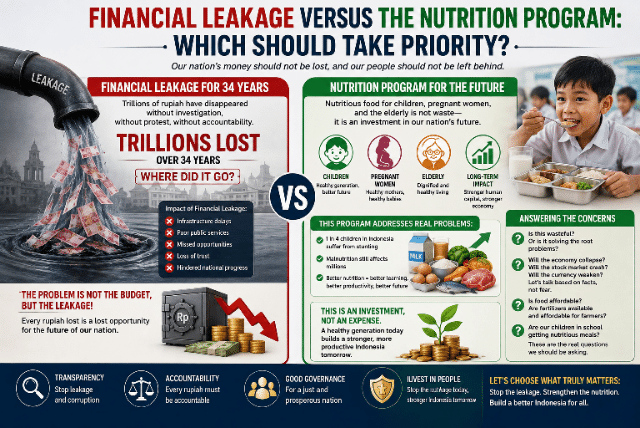
- Financial leakage versus the nutrition program: which should take priority?
- Why is the disappearance of trillions of rupiah not considered a major issue?
- Nutritious food is more than just an expense; is this program a waste of resources?
- Is it true that government spending always poses a threat to the economy?
- What about food and fertilizer prices?
- Focusing on two priorities simultaneously
Financial leakage versus the nutrition program: which should take priority?
Amidst the debate on government policy, a key question arises: why is there so much focus on programs designed to meet the population’s nutritional needs, while the issue of massive financial losses or leakage—persisting for decades—often receives little attention?
This question has become increasingly relevant as programs providing nutritious food to children, pregnant women, and vulnerable groups face criticism.
LATEST NEWS: The Ministry of Labour Prepares Young Talent to Launch Startups and Create Jobs
Some view programs aimed at improving community nutrition as potentially wasteful and a burden on the economy.
However, proponents argue that the nutrition program is about more than just distributing food; it is seen as an investment in the quality of Indonesia’s human capital.
Why is the disappearance of trillions of rupiah not considered a major issue?
One point of criticism is the lack of attention paid to the alleged disappearance of vast sums of money from Indonesia over the course of decades.
If budget leakage or financial outflows detrimental to the state are indeed occurring, the issue goes far beyond the nominal amount involved. These funds should be used to finance development, improve public facilities and education, strengthen the healthcare system, and meet the community’s needs.
This raises the question: why does the debate over the use of the social program budget receive so much attention, while the issue of missing or misappropriated state funds also deserves serious scrutiny?
LATEST NEWS: Governor Bobby Nasution’s free school program eases the burden on parents of students on Nias
Naturally, any claims regarding the amount of missing funds must be substantiated by data, audits, and transparent legal procedures. However, the principle is clear: the management of state funds must be transparent and subject to public oversight.
Nutritious food is not merely a cost
Providing nutritious food to children, pregnant women, and vulnerable groups serves a broader purpose than simply meeting daily nutritional needs.
Nutritional issues during growth periods can have long-term consequences for health, learning ability, productivity, and the quality of human capital.
Therefore, efforts to tackle stunted growth and malnutrition can be viewed as a long-term investment. Children who grow up healthy and receive adequate nutrition have a better chance of optimal development.
The question, then, is not only how much it will cost, but also how much the government will have to bear if nutritional problems persist for years.
LATES NEWS: SMPN 4 Sitolu Ori’s dream of a permanent building is finally coming true
Is this program a waste of money?
Criticism of the nutritious food program is certainly justified.
Programs with large budgets require robust monitoring systems. Procurement, distribution, quality, the number of beneficiaries, and even evaluation mechanisms must be subject to transparent oversight.
Any instances of budget leakage, price inflation, poor-quality food, or distribution errors must be rectified immediately.
However, it is unfair to label an entire program as wasteful simply because it requires a large budget.
LATEST NEWS: Selection process for National Vocational Training Programs, Cohort 4, opened on August 13, 2026
A public program should be evaluated based on its benefits, effectiveness, efficiency, and outcomes, rather than solely on the size of the budget spent. Is it true that government spending always poses a threat to the economy?
Another concern relates to the impact on the economy. Unchecked government spending can indeed entail financial risks if not properly designed and managed.
However, spending on social programs does not automatically lead to economic collapse, a stock market crash, or currency devaluation.
The impact depends on many factors: funding sources, the size of the budget, the effectiveness of the spending, financial conditions, market reactions, inflation, and the overall economic situation.
LATEST NEWS: The Ministry of Labor provides access to training and employment for people who have overcome drug addiction
Therefore, the debate should not stop at the question “how much money is being spent?” but should move on to ask “what are the results of that spending?”
What about food and fertilizer prices?
An equally important question is: what is the state of the food supply chain from start to finish?
If the government intends to implement a large-scale nutritious food program, food availability is a crucial factor.
Are food prices affordable?
Do farmers obtain fertilizer at a reasonable price? Can domestic food production meet demand? Is distribution efficient?
Nutrition-focused programs can have an even broader economic impact if designed to optimally integrate domestic food production.
High demand for eggs, fish, meat, vegetables, rice, fruit, and other products can create markets for farmers, livestock producers, fishers, and food enterprises. However, this will only happen if these markets are well-managed and do not cause market distortions or waste.
LATEST NEWS: Nine digital assets of the future: the foundation for wealth in the digital age
Focusing on two priorities simultaneously
The debate surrounding nutrition programs should not force the public to choose between curbing budgetary leakages and improving the population’s nutrition. Both are equally important.
The country needs a transparent budget management system to ensure that every rupee is spent responsibly. At the same time, the country requires long-term investments to ensure children grow up healthy, receive quality education, and become more productive.
The more relevant question, therefore, is not whether nutrition programs should exist, but how to ensure they deliver maximum benefits cost-efficiently and under strict oversight.
LATEST NEWS: Students can now gain practical experience at Telkomsel via Virtuship
Ultimately, public funds must be used to maximize the public good. Leakages must be plugged and waste prevented, but the population’s basic needs—including food and nutrition—must not be neglected.
The budget debate should focus not only on the amount of money spent but also on where the funds go, who benefits, and what changes are brought about in Indonesia. ***tok