
Editor’s Note
- Dr. Aliansyah teaches intelligence to future prosecutors
- Prosecutors must have intelligence knowledge
- The scope of intelligence is regulated by the State Intelligence Act
- 3 Key Functions of Intelligence in Law Enforcement
Dr. Aliansyah teaches intelligence to future prosecutors
To develop prosecutors who are competent in their judgment and knowledge, professional, and ethical, future prosecutors must undergo various training and education programs. These programs prepare prosecutors who are ready to serve and enforce the law, especially in today’s modern and digital age.
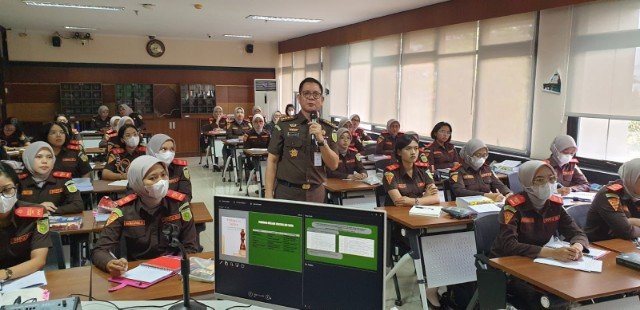
The Indonesian Public Prosecution Service’s Education and Training Bureau organized the Public Prosecution Service’s Education and Training Program (PPPJ) for batch 83, first batch, 2026.
Future public prosecutors were trained in various educational and academic subjects, including morality, integrity, legal provisions, standard operating procedures (SOPs) for law enforcement, dedication to law enforcement, national insight, and intelligence expertise, which every public prosecutor must possess.
On Tuesday, February 10, 2026, the Public Prosecution Service’s Education and Training Bureau (Badiklat Kejagung) presented the “Indera Sakti Adhyaksa” (Indera Sakti Adhyaksa) program. Dr. Aliansyah, S.H., M.H. Aliansyah, Head of the Legal Information and Advice Department of the Public Prosecution Service’s Legal Information Center (Puspenkum), gave a presentation on this program.
“Indera Sakti Adhyaksa” is one of the Public Prosecution Service’s strategic tools to support law enforcement.
He explained that the legal basis for the Public Prosecution Service’s intelligence function lies in Law No. 16 of 2004 on the Indonesian Public Prosecution Service, as amended by Law No. 11 of 2021, and Law No. 17 of 2011 on the State Intelligence Service.
Prosecutors must possess intelligence knowledge
The former head of the Padang Public Prosecution Service stated that to become a reliable and worthy prosecutor, every prosecutor must possess intelligence knowledge. This means that intelligence, as knowledge, is a necessary prerequisite for achieving national vigilance and resilience.
“The essence of intelligence is intelligence, the ability to process thoughts, the ability to develop strategies, and the ability to predict. The power of espionage is one of the keys to successful information gathering. Even the smallest detail can be very useful if we utilize it optimally,” Aliansyah said.
Furthermore, Aliansyah explained the definition of intelligence based on Article 1, paragraph (1), number 1 of the State Intelligence Act, which states that intelligence encompasses the knowledge, organization, and activities related to policymaking and strategic decision-making based on the analysis of information and facts obtained through specific working methods.
Scope of the intelligence services as regulated in the State Intelligence Act
He also explained the scope of the intelligence services as regulated in Article 7 of the State Intelligence Act, which includes domestic and foreign intelligence, defense or military intelligence, police intelligence (law enforcement intelligence), and intelligence services within ministries/non-ministerial government agencies.
According to Article 9 of the State Intelligence Act, the state intelligence services consist of the State Intelligence Service (BIN), the Indonesian National Armed Forces (TNI), the Indonesian Public Prosecution Service (AGO), and intelligence services of ministries/non-ministerial government agencies.
According to Aliansyah, the Indonesian Public Prosecution Service specifically conducts intelligence services for law enforcement, as stipulated in Article 13 of the State Intelligence Act.
In this context, the Public Prosecution Service’s intelligence service plays a crucial role in the law enforcement system, both preventatively and repressively.
He added that the essence of the Public Prosecution Service’s intelligence services encompasses various strategic areas, including ideology, politics, economics, finance, socio-cultural affairs, defense and security, and public order and safety, as stipulated in Article 30B of the Attorney General’s Act.
3 Key Functions of Intelligence Services in Law Enforcement
Furthermore, intelligence services in law enforcement are part of the state intelligence services carried out by the Public Prosecution Service in support of law enforcement, as laid down in Directive No. 21 of 2021 of the Public Prosecution Service. ***adh