Editor’s Note
- Crypto regulations in Indonesia change completely, supervision by the Financial Services Authority (OJK)
- Changes in crypto regulations in Indonesia
- Types of digital financial assets (crypto)
- Risks of each type of crypto
- Crypto: investment or gambling?
- Account security and risk management
- The future of crypto in Indonesia
Crypto regulations in Indonesia change completely, supervision by the OJK
The major changes in crypto regulations in Indonesia took effect on January 10, 2025, with supervision shifting from Bappebti (Regulatory Agency for Commodity Futures Trading) to the Financial Services Authority (OJK).
Crypto is no longer considered a commodity, but a digital financial asset, comparable to stocks or mutual funds, with a focus on consumer protection.
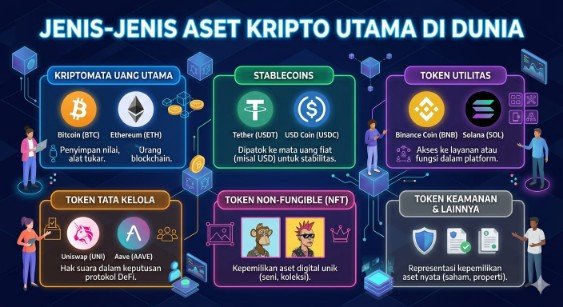
We explain various types of crypto assets, such as Layer 1 (Bitcoin, Ethereum), Layer 2 (Arbitrum), Stablecoins (USDT, USDC), and Real World Assets (RWA), along with the associated risks.
The discussion also addressed the views of religious organizations (MUI, Muhammadiyah, Nahdlatul Ulama) regarding crypto as an investment or gambling, emphasizing the importance of research for investors.
The practical section covered measures for account security (2FA, offline key storage, registered platforms) and risk management (diversification, trading plans).
Indonesia’s position as a global crypto giant and the potential of blockchain for the national economy were also highlighted, with the hope that the Indonesian Financial Services Authority (OJK) would strike a balance between innovation and consumer protection.
Changes to crypto regulations in Indonesia
As of January 10, 2025, crypto supervision will shift from Bappebti to OJK. Crypto will be treated as a digital financial asset, no longer as a commodity, similar to stocks or mutual funds. The focus of regulation is shifting from transparency to consumer protection.
Types of digital financial assets (crypto)
Layer 1 (L1): Basic infrastructure such as Bitcoin and Ethereum, secure but slow and expensive. Layer 2 (L2): Scalability solutions such as Arbitrum, which enable fast and low-cost transactions.
Stablecoin: Coins whose value is stable because they are backed by real assets (e.g., US dollars), used to park money.
Real assets (RWA): Digital tokens that represent ownership of physical assets, such as gold, real estate, or bonds.
Risks of each type of cryptocurrency
- Layer 1: Risk of large price fluctuations.
- Layer 2: Risks related to smart contracts.
- Stablecoin: Risk if the value drops suddenly.
- RWA: Legal risks related to the physical asset. Crypto: Investing or gambling?
Religious organizations hold different views:
MUI: Allows under strict conditions (there are underlying assets, without excessive speculation).
Muhammadiyah: Prohibits due to high speculation and unclear value.
NU: Prohibits for similar reasons, but opens the door to strict regulation.
Investors conduct in-depth research (white paper, team, tokenomics), unlike gamblers who simply bet on the price.
Account security and risk management
Account security:
- Enable two-factor authentication (2FA).
- Store private keys offline.
- Use platforms officially registered with the Japanese financial regulator (OJK) or the UK commodity futures trading regulator (Bappebti).
- Check wallet addresses carefully before transferring funds.
Risk management:
Diversify your portfolio (e.g., 50% Bitcoin, 30% L1/L2, 20% stablecoins). Develop a trading plan (capital, profit target, loss limit).
Stick to your trading plan and avoid emotional decisions.
The future of crypto in Indonesia
Indonesia ranks seventh globally in terms of crypto adoption. Major institutions (BRI Ventures, Pegadaian, Pos Indonesia) are beginning to explore blockchain technology.
The success of the crypto ecosystem in the era of the OJK (Indonesian financial regulator) will depend on the balance between technological innovation and consumer protection. ***tok