
Editor’s note
- Could the price of gold fall by 50%? Lessons from the history of global gold movements
- Lessons from history: Gold has fallen after reaching a peak
- 1970s to early 1980s
- 2011 Annual Cycle
- Why could a major correction occur?
- Will history repeat itself?
- A scenario with a 50% drop
- Factors that could slow down a decline in the price of gold
- Investment strategies for a possible correction
Could the price of gold fall by 50%? Lessons from the history of global gold movements
Gold has long been known as a hedge against various economic conditions.
When inflation rises, geopolitical uncertainty increases, or financial markets become volatile, many investors turn to gold as a supposed safe haven. However, one important fact is often overlooked: the price of gold does not always rise.
LATEST NEWS: Bitcoin remains uncertain: has the bottom been reached yet?
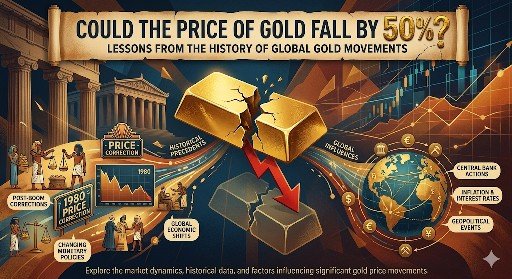
History shows that after reaching very high peaks, gold has experienced several major corrections that have surprised many investors. Therefore, a question increasingly discussed by market participants is: could the price of gold fall by 50% after reaching a new record?
Lessons from history: Gold has fallen after a peak
One of the biggest mistakes investors make is assuming that a rising asset will continue to rise indefinitely.
However, virtually all financial assets move in cycles consisting of phases of rise, euphoria, peak, correction, and recovery.
1970s to early 1980s
In the late 1970s, gold prices shot up due to high inflation and global economic uncertainty. Many investors at the time believed that the rise in gold would last forever.
However, after the peak in 1980, gold prices fell for years.
Investors who had bought at the peak had to wait a very long time to recoup their investment.
LATEST NEWS: Bitcoin movement: between hope for a bull market and the threat of a major correction
The 2011 cycle
A similar phenomenon occurred again in 2011, when gold reached a record high. The European debt crisis, loose monetary policy, and global economic uncertainty led to enormous demand for gold.
After the euphoria subsided, gold prices fell significantly. Many investors who were previously convinced that gold would continue to set new records have now seen a substantial decline in the value of their investments.
Why might a major correction occur?
The rise in the gold price is usually caused by a combination of factors, such as:
- Fear of inflation.
- Geopolitical instability.
- Weakening of major currencies.
- Low interest rates.
- Large capital flows into safe investments.
However, when these factors diminish, investors shift their money to other assets with a higher potential return. As a result, demand for gold falls and prices begin to correct.
LATEST NEWS: Tomorrow, June 18, MagangHub Batch III closes
This type of correction is not unusual. In fact, in market cycles, declines following extreme rises are a normal part of the market cycle.
Will history repeat itself? A common saying in the investment world is that history never repeats itself exactly, but often follows similar patterns.
This means that there is no guarantee that the gold price will experience the same decline as in previous cycles.
However, historical patterns show that every time gold reaches a euphoric phase and sets new records, the risk of a major correction also increases.
Investors must therefore understand that sharp price increases are usually followed by periods of consolidation or even significant declines.
LATEST NEWS: Minister of Labor Emphasizes Strengthening of Occupational Safety and Health (K3) and Responsible Governance
A scenario with a 50% decline
In a scenario discussed by various market analysts, a decline of up to 50% is not impossible if the gold price peaks around US$ 5,600 per troy ounce, based on historical patterns.
With this assumption, the price level around US$ 2,800 per troy ounce is a level to watch as a possible target for a long-term correction. It must be emphasized that this figure is not a definitive forecast, but a simulation based on patterns that have occurred in previous cycles. Many factors can make a correction less or deeper than expected.
Factors that could influence the decline in gold
Although the risk of a correction always exists, current economic conditions are somewhat different from those in the past.
Several factors could support the gold price, including:
- High global debt burden.
- Prolonged geopolitical uncertainty.
- Gold purchases by central banks in various countries.
- Concerns about the stability of the global financial system.
- The possibility of a prolonged devaluation of fiat currencies.
These factors could act as a buffer and prevent the correction in the gold price from being as deep as in previous cycles.
LATEST NEWS: Generation Z and the challenges of buying a home: an increasingly expensive dream, but still achievable
Investment strategies for dealing with potential corrections
For investors, the most important lesson is not to try to predict the highest or lowest point perfectly, but to understand that every asset goes through a cycle.
Some principles that can be applied are:
- Avoid purchases purely out of fear of missing out on price increases.
- Make purchases gradually.
- Diversify your investment portfolio.
- Make a plan for major corrections.
- Focus on long-term investment goals.
With this approach, investors can be better prepared for market volatility without being carried away by emotional decisions.
Conclusion
History shows that gold has experienced significant declines after reaching record highs. The events of 1980 and 2011 remind us that even the safest assets are not immune to major corrections.
Should gold prices ever reach very high levels, a scenario of a 50% drop cannot be completely ruled out. In this illustration, the area around US$ 2,800 could be a valuable correction target if the previous price were around US$ 5,600.
However, investors must also understand that current economic conditions have different characteristics from those of the past. Therefore, history should be used as a guide to understand risks, not as an instrument to predict the future with certainty.
Vigilance, discipline, and risk management remain essential to weather every market cycle. ***tok