

Editor’s note
- Understanding Short Selling: How to Profit from Falling Stock Prices and the Risk of Loss
- How does short selling work?
- Example of a profit simulation
- The risks can be very high
- Understanding margin calls and forced sales
- What are the rules for short selling in Indonesia?
- Short selling is more than just betting that a stock will fall
Understanding Short Selling: How to Profit from Falling Stock Prices and the Risk of Loss
When investing in stocks, profit is generally made when share prices rise. However, there is a strategy that allows investors to make a profit when share prices fall. This strategy is known as short selling.
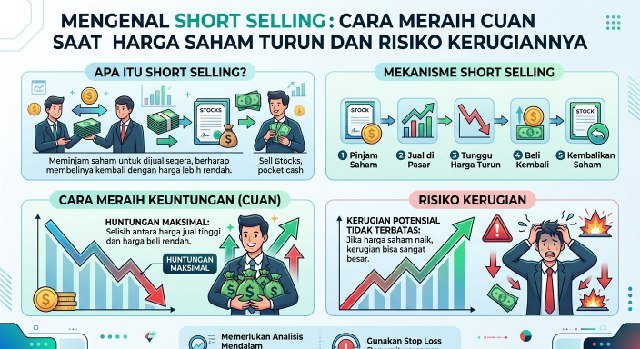
Short selling essentially reverses the logic of traditional investing. Investors do not buy shares first to sell them later when the price rises. Instead, investors borrow shares, sell them, and then hope to buy them back at a lower price to return to the lender.
LATEST NEWS: Deputy Minister of Manpower visits shoe factory in Serang; PT Nikomas Gemilang employs 53,000 workers
The difference between the selling price and the repurchase price represents the investor’s potential profit.
How does short selling work?
Simply put, a short selling transaction consists of several stages.
First, the investor borrows shares. Investors obtain shares through mechanisms permitted by securities firms or brokers.
Second, the borrowed shares are sold. For example, an investor borrows 1,000 shares currently priced at IDR 1,000 per share. These shares are then sold for a total amount of IDR 1 million.
Third, the investor waits for price movements. If the investor’s prediction is correct and the share price falls, the investor can buy the shares back at a lower price. Fourthly, the shares are returned. The repurchased shares are returned in accordance with the obligations to the lender.
The profit is simply the difference between the original sale price and the repurchase price, after deducting transaction costs, borrowing costs, and other obligations.
LATEST NEWS: Press Freedom Protection Law
Example of a profit simulation
For instance, an investor sells 1,000 shares short at IDR 1,000 per share.
Initial sale value: 1,000 × IDR 1,000 = IDR 1,000,000
The share price subsequently falls to IDR 700 per share.
The investor repurchases 1,000 shares: 1,000 × Rp 700 = Rp 700,000
Simply put, the difference is: Rp 1,000,000 – Rp 700,000 = Rp 300,000
This means the investor realizes a gross profit of Rp 300,000, before deducting transaction costs, share borrowing costs, interest or financing costs (if applicable), and other obligations.
The risks can be very high
This is the key difference between short selling and conventional share purchasing.
When buying shares, losses on a non-leveraged position are limited to the value of the investment—specifically, if the share price drops to near zero.
With short selling, the situation is different. Suppose a share is sold short for 1,000 rupiah, but instead of falling, the price rises to 1,500 rupiah. The investor must buy back the shares for 1,500 rupiah: 1,000 × 1,500 rupiah = 1,500,000 rupiah.
This is despite the fact that the shares were previously sold for 1,000,000 rupiah.
Gross loss: 1,500,000 rupiah – 1,000,000 rupiah = 500,000 rupiah.
The problem is that, theoretically, there is no upper limit to the share price. If the price continues to rise to 2,000 rupiah, 3,000 rupiah, 5,000 rupiah, or higher, the obligation to buy back the shares increases accordingly.
Consequently, the potential loss associated with short selling is theoretically unlimited.
LATEST NEWS: The ultimate Galaxy S experience starting at IDR 9 million
Understanding margin calls and forced sales
Short selling is typically linked to collateral or margin requirements. Investors must comply with the requirements set by brokerage firms and regulatory bodies.
If the value of the collateral no longer meets the requirements, investors may receive a margin call. This is a request to increase the collateral or meet margin obligations.
Failure to meet these obligations may result in the position being forcibly closed or subjected to a forced sale or liquidation in accordance with applicable mechanisms.
This situation can lead to greater losses for investors, as positions may have to be closed at a time when market conditions are unfavorable.
What are the rules for short selling in Indonesia?
Short selling is not a transaction that all investors can freely execute with all stocks.
In Indonesia, this activity falls under capital market regulations. Through POJK Number 6 of 2024, the Indonesian financial regulator (OJK) regulates the financing of securities transactions by securities firms for clients, as well as short-selling transactions by securities firms. These regulations cover aspects such as governance, risk management, client and securities requirements, transaction mechanisms, and sanctions.
LATEST NEWS: The secret to building wealth through debt
Investors wishing to engage in short selling must therefore comply with the requirements set by securities firms, provisions regarding tradable securities, collateral requirements, and applicable regulations from the Indonesian stock exchange and the OJK.
It is also important to note that OJK Regulation Number 13 of 2026—adopted on September 15, 2026, and published on September 17, 2026—governs stock exchange shareholders and the demutualization of the stock exchange. There are no specific regulations enabling short selling as of September 15, 2026.
As capital market regulations are subject to change, investors should consult the latest provisions from the OJK, the IDX, and securities firms before executing transactions.
Short selling is more than just betting that a stock will fall.
Short selling requires an understanding of risks that are far more complex than those involved in standard stock transactions.
Investors must not only analyze the company’s fundamental and technical aspects but also understand:
– the stock lending mechanism;
– margin and collateral requirements; – transaction costs and borrowing costs;
– the risk of a margin call;
– the risk of forced liquidation;
– the liquidity of the stock;
– price volatility;
– and regulations imposed by supervisory authorities and securities firms.
Small errors in prediction can lead to significant losses if the share price moves sharply against the investor’s position.
LATEST NEWS: Vespa Community Visits Governor Bobby Nasution
Conclusion
Short selling allows investors to profit when share prices fall, but this strategy entails different risk characteristics than standard stock investments.
Simply put: borrow shares → sell → price drops → buy back → return shares → the difference becomes a potential profit.
Conversely: borrow shares → sell → price rises → buy back at a higher price → incur a loss.
Since share prices can theoretically keep rising, potential losses from short selling can also be substantial.
Short selling is therefore not merely a strategy for profiting from anticipated price declines. It requires a thorough understanding of transaction mechanisms, risk management, margin requirements, and applicable capital market regulations.
Disclaimer: This article is intended solely for educational purposes and does not constitute a recommendation to short sell or trade any specific stock. Short selling involves high risks, including the potential for theoretically unlimited losses. Investors should fully understand all terms, costs, margin requirements, and risks through a licensed broker before entering into a transaction. ***tok
Catatan Redaksi
- Mengenal Short Selling: Cara Meraih Cuan Saat Harga Saham Turun dan Risiko Kerugiannya
- Bagaimana Cara Kerja Short Selling?
- Contoh Simulasi Keuntungan
- Risikonya Bisa Sangat Besar
- Mengenal Margin Call dan Forced Sell
- Bagaimana Regulasi Short Selling di Indonesia?
- Short Selling Bukan Sekadar Menebak Saham Akan Turun
Mengenal Short Selling: Cara Meraih Keuntungan Saat Harga Saham Turun dan Risiko Kerugiannya
Dalam investasi saham, keuntungan umumnya diperoleh ketika harga saham naik. Namun, ada strategi yang memungkinkan investor memperoleh keuntungan ketika harga saham justru mengalami penurunan. Strategi tersebut dikenal sebagai short selling.
Short selling pada dasarnya membalik logika investasi konvensional. Investor tidak membeli saham terlebih dahulu untuk kemudian menjualnya ketika harga naik. Sebaliknya, investor meminjam saham, menjualnya, kemudian berharap dapat membeli kembali saham tersebut dengan harga yang lebih rendah untuk dikembalikan kepada pihak yang meminjamkan.
Selisih antara harga jual dan harga beli kembali menjadi potensi keuntungan investor.
Bagaimana Cara Kerja Short Selling?
Secara sederhana, terdapat beberapa tahapan dalam transaksi short selling.
Pertama, investor meminjam saham. Investor memperoleh saham melalui mekanisme yang diperbolehkan oleh perusahaan efek atau broker.
Kedua, saham yang dipinjam dijual. Misalnya, investor meminjam 1.000 lembar saham yang saat itu memiliki harga Rp1.000 per lembar. Saham tersebut kemudian dijual dengan nilai total Rp1 juta.
Ketiga, investor menunggu pergerakan harga. Jika prediksi investor benar dan harga saham mengalami penurunan, investor dapat membeli kembali saham tersebut dengan harga yang lebih murah.
Keempat, saham dikembalikan. Saham yang telah dibeli kembali dikembalikan sesuai kewajiban kepada pihak yang memberikan pinjaman.
Keuntungan secara sederhana berasal dari selisih antara harga jual awal dan harga pembelian kembali, setelah memperhitungkan biaya transaksi, biaya peminjaman, dan kewajiban lainnya.
Contoh Simulasi Keuntungan
Misalnya seorang investor melakukan short selling sebanyak 1.000 lembar saham pada harga Rp1.000 per lembar.
Nilai penjualan awal: 1.000 × Rp1.000 = Rp1.000.000
Kemudian harga saham turun menjadi Rp700 per lembar.
Investor membeli kembali 1.000 lembar saham: 1.000 × Rp700 = Rp700.000
Secara sederhana, selisihnya adalah: Rp1.000.000 – Rp700.000 = Rp300.000
Artinya, investor memperoleh keuntungan kotor Rp300.000, sebelum memperhitungkan biaya transaksi, biaya pinjaman saham, bunga atau biaya pembiayaan jika ada, serta kewajiban lainnya.
Risikonya Bisa Sangat Besar
Di sinilah perbedaan utama short selling dengan membeli saham secara konvensional.
Ketika membeli saham, kerugian dari posisi tanpa leverage secara sederhana dibatasi sampai nilai investasi yang ditanamkan, yaitu ketika harga saham turun hingga mendekati nol.
Pada short selling, situasinya berbeda. Misalnya saham dijual secara short pada harga Rp1.000, tetapi bukannya turun, harga justru naik menjadi Rp1.500.
Investor harus membeli kembali saham tersebut pada harga Rp1.500: 1.000 × Rp1.500 = Rp1.500.000
Padahal saham tersebut sebelumnya dijual dengan nilai Rp1.000.000.
Kerugian kotor: Rp1.500.000 – Rp1.000.000 = Rp500.000
Masalahnya, harga saham secara teori tidak memiliki batas maksimum. Jika harga terus naik menjadi Rp2.000, Rp3.000, Rp5.000, atau lebih tinggi, kewajiban untuk membeli kembali saham juga semakin besar.
Karena itu, risiko kerugian pada short selling secara teori tidak memiliki batas atas.
Mengenal Margin Call dan Forced Sell
Short selling biasanya berkaitan dengan persyaratan jaminan atau margin. Investor harus memenuhi ketentuan yang ditetapkan perusahaan efek dan regulator.
Jika nilai jaminan tidak lagi memenuhi persyaratan, investor dapat menghadapi margin call, yaitu permintaan untuk menambah dana atau memenuhi kewajiban margin.
Apabila kewajiban tersebut tidak dipenuhi sesuai ketentuan, posisi dapat ditutup secara paksa atau forced sell/liquidation sesuai mekanisme yang berlaku.
Situasi ini dapat membuat investor mengalami kerugian yang lebih besar karena posisi harus ditutup ketika kondisi pasar mungkin tidak menguntungkan.
Bagaimana Regulasi Short Selling di Indonesia?
Short selling bukan transaksi yang dapat dilakukan secara bebas oleh seluruh investor melalui semua saham.
Di Indonesia, aktivitas ini berada dalam kerangka regulasi pasar modal. OJK melalui POJK Nomor 6 Tahun 2024 mengatur pembiayaan transaksi efek oleh perusahaan efek bagi nasabah dan transaksi short selling oleh perusahaan efek. Regulasi tersebut antara lain mencakup aspek tata kelola, manajemen risiko, persyaratan nasabah dan efek, mekanisme transaksi, serta sanksi.
Dengan demikian, investor yang ingin melakukan short selling harus memperhatikan persyaratan dari perusahaan efek, ketentuan efek yang dapat ditransaksikan, persyaratan jaminan, serta aturan Bursa Efek Indonesia dan OJK yang berlaku.
Perlu diluruskan pula bahwa POJK Nomor 13 Tahun 2026 yang ditetapkan 15 September 2026 dan diundangkan 17 September 2026 mengatur tentang pemegang saham Bursa Efek dan demutualisasi Bursa Efek, bukan merupakan regulasi khusus yang mengaktifkan short selling pada 15 September 2026.
Karena aturan pasar modal dapat diperbarui, investor perlu memeriksa ketentuan terbaru dari OJK, BEI, dan perusahaan sekuritas sebelum melakukan transaksi.
Short Selling Bukan Sekadar Menebak Saham Akan Turun
Short selling membutuhkan pemahaman terhadap risiko yang jauh lebih kompleks dibandingkan transaksi saham biasa.
Investor tidak hanya perlu menganalisis fundamental dan teknikal perusahaan, tetapi juga harus memahami:
– mekanisme peminjaman saham;
– persyaratan margin dan jaminan;
– biaya transaksi dan biaya peminjaman;
– risiko margin call;
– risiko forced liquidation;
– likuiditas saham;
– volatilitas harga;
– serta ketentuan regulator dan perusahaan efek.
Kesalahan prediksi yang kecil dapat berubah menjadi kerugian besar apabila harga saham bergerak tajam berlawanan dengan posisi investor.
Kesimpulan
Short selling memungkinkan investor mendapatkan keuntungan ketika harga saham turun, tetapi strategi ini memiliki karakteristik risiko yang berbeda dari investasi saham biasa.
Secara sederhana: Pinjam saham → jual → harga turun → beli kembali → kembalikan saham → selisih menjadi potensi keuntungan.
Sebaliknya: Pinjam saham → jual → harga naik → beli kembali lebih mahal → mengalami kerugian.
Karena harga saham secara teori dapat terus naik, potensi kerugian short selling juga dapat menjadi sangat besar.
Oleh sebab itu, short selling bukan sekadar strategi untuk mencari keuntungan dari saham yang diperkirakan turun. Strategi ini membutuhkan pemahaman mendalam mengenai mekanisme transaksi, manajemen risiko, persyaratan margin, dan regulasi pasar modal yang berlaku.
Disclaimer edukasi: tulisan ini hanya untuk tujuan edukasi dan bukan merupakan rekomendasi untuk melakukan short selling atau transaksi saham tertentu. Short selling memiliki risiko tinggi, termasuk potensi kerugian yang secara teori tidak terbatas. Investor sebaiknya memahami seluruh ketentuan, biaya, persyaratan margin, dan risiko melalui perusahaan efek yang berizin sebelum melakukan transaksi. ***tok