

Editor’s note
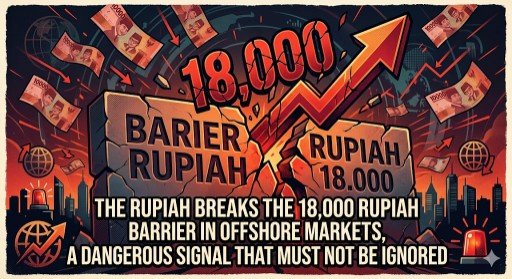
The Rupiah breaks the 18,000 rupiah barrier in offshore markets, a dangerous signal that must not be ignored
What exactly is the NDF market?
A signal of economic uncertainty
The Rupiah breaks the 18,000 rupiah barrier in offshore markets, a dangerous signal that must not be ignored
There is an important signal from global financial markets that everyone needs to be aware of, especially those concerned about economic conditions and their personal financial future.
This news comes from offshore markets and, frankly, is not good news for the rupiah.
LATEST NEWS: Escape poverty and build true wealth
On May 27, 2026, the rupiah exchange rate in offshore markets reportedly broke the psychological barrier of 18,000 rupiah per US dollar.
This figure is very concerning because it reflects growing concern in the market regarding the economic outlook and the future exchange rate of the rupiah.
Interestingly, this situation differs from that in the domestic market. Within the rupee, the rate remains relatively stable around 17,775 rupees per US dollar.
At the same time, however, the rupee rate on the offshore market, the so-called NDF market (Non-Deliverable Forward), has risen to above 18,000 rupees.
LATEST NEWS: Ministry of Manpower: Competency certification strengthens the competitiveness of graduates undergoing internships
What exactly is the NDF market?
Simply put, the NDF market is an offshore currency trading market frequently used by international investors, major financial institutions, and international market participants to anticipate exchange rate movements without having to exchange physical cash.
This activity often takes place in global financial centers such as Singapore, Hong Kong, London, and New York.
Because large market participants with significant financial resources are involved, price movements on the NDF market are often considered an early indicator of market expectations regarding the direction of a country’s currency.
Even more concerning is that one-year NDF contracts have even been traded at rates above 18,245 rupees per US dollar. This means that some global market participants expect the pressure on the rupiah to persist for some time.
LATEST NEWS: Recommended games to make money in DeepSeek 2026 version
Signs of economic uncertainty
The market is giving signals that economic uncertainty remains quite high. Movements in foreign markets often provide early indications of international investor sentiment, which can ultimately impact the stock market, the bond market, and even capital flows to and from Indonesia.
For the general public, the weakening of the rupiah is more than just a number on a trading screen. If the dollar strengthens, various imported goods could become more expensive.
Companies’ production costs could rise, the prices of certain basic necessities could increase, and inflationary pressure could build up in daily life.
LATEST NEWS: The Ministry of Labor monitors labor conflict at PT Epson
The question we must ask ourselves now is: how can we protect our personal finances amidst this uncertainty?
Some choose to replenish their emergency fund. Others diversify their assets, reduce their consumer debt, or improve their skills and capabilities to remain competitive amidst rapid economic changes.
Whatever the strategy, one thing is clear: understanding the signals the market is giving is much better than ignoring them.
For when major changes occur, those who are prepared generally have a greater chance of surviving and even thriving.
In your opinion, what is the most suitable strategy to deal with the possibility of a weakening rupiah and future price increases? ***tok