
Editor’s Note
- Profit Opportunity: Waste-to-Electricity Projects Are Hugely Expensive
- Waste heaps reach hundreds of tons per day
- 26 regions/cities have significant potential for waste management
Profit Opportunity: Waste-to-Electricity Projects Are Hugely Expensive
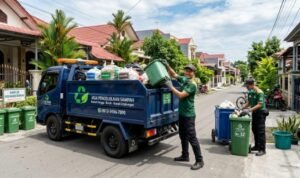
The Ministry of the Environment (KLH) has announced that the Waste-to-Electricity (PSEL) or Waste-to-Energy (WTE) project contributes only 13% to waste management in Indonesia. However, this project is demonstrably expensive.
Minister of the Environment Hanif Faisol Nurofiq indicated that the Waste-to-Energy project, which will be implemented in several major cities, will only be able to process a small portion of Indonesia’s total waste production.
Waste heaps reach hundreds of tons per day
He stated that this percentage is still far below expectations for processing hundreds of thousands of tons of waste per day.
“Nationally, we process this waste through various methods. What we currently know as waste to energy (WET) can only process 13% of our waste. There is still much work to be done,” Hanif said during a working meeting with Committee XII of the Indonesian House of Representatives (DPR RI) in Jakarta on Monday, January 26, 2026.
To fully solve the national waste problem, Hanif said, a combination of different technological approaches is needed; it cannot rely solely on waste management (PSEL). Moreover, a significant budget is needed for the construction of adequate waste management facilities throughout Indonesia.
“Just for the physical aspects, we can solve the waste problem if almost 115 trillion Indonesian rupiah is made available for the construction of these facilities. The daily operating costs are 34 trillion rupiah,” he explained.
26 regions/cities have significant potential for waste management
Although the contribution has not yet been fully utilized, the government is continuing the Waste Management Project (PSEL) in several key regions.
Hanif indicated that 10 agglomerations in 26 regions/cities have significant potential for waste management through the waste management program. This has been communicated to the Coordinating Minister of Food and Agriculture and is being monitored by the Nusantara Energy Investment Management Agency (BPI Danantara).
“These are Greater Denpasar, Greater Yogyakarta, Greater Bogor, Greater Bekasi, Greater Tangerang, Medan, Semarang, Lampung, Surabaya, and Serang. Based on the information received so far, four agglomerations have completed their auctions, and construction is expected to begin in March,” he added.
The four metropolitan areas that have registered for the BPI Danantara auction are Greater Denpasar, Greater Yogyakarta, Greater Bogor, and Bekasi.
Unfortunately, the two largest metropolitan areas, the Special Region of Jakarta and Greater Bandung, are not yet ready to implement the waste management project. This is despite the enormous potential waste production in these two regions, which amounts to 8,000 tons and 5,000 tons per day, respectively. ***obs