North Sumatra encourages updating of the Village Index to accelerate the realization of independent villages
The provincial government of North Sumatra (Pemprov) encourages district and city administrations to accelerate the updating of the Village Index. This is essential to increase the number of independent villages and to reduce the number of underdeveloped and severely underdeveloped villages in North Sumatra.
This effort is considered crucial because the data from the Village Index forms a basis for capturing the overall condition and development of villages, enabling more targeted development policies and other policy lines.
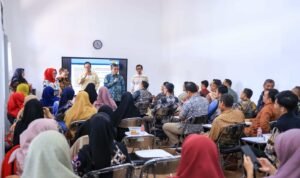
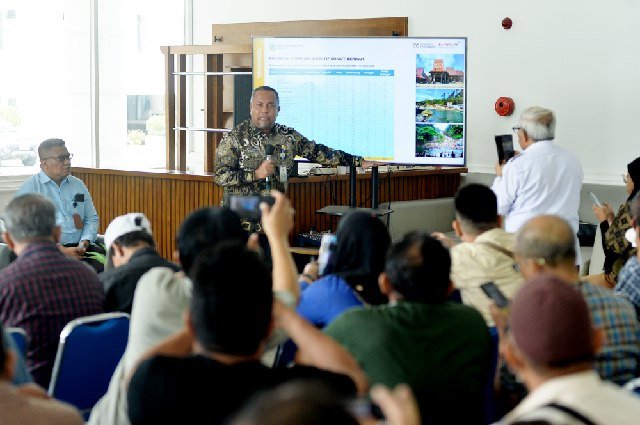
This was announced by Muhammad Suib, Acting Head of the Office for Community Development, Village Management, Population, and Civil Registry of North Sumatra (PMD Dukcapil), during a press conference of the Office for Communication and Information Technology of North Sumatra (Kominfo) in the Dekranasda lobby of the office of the Governor of North Sumatra, Jalan Pangeran Diponegoro No. 30, Medan, on Friday, August 28, 2026.
Suib explained that the Village Index is used to measure the performance of villages based on six dimensions: Basic Services, Social Affairs, Economy, Environment, Accessibility, and Governance.
The index also serves as a measure of the progress and independence of villages and forms the basis for the distribution of village funds.
“We have brought the issue of North Sumatra’s image to the attention of the Governor and the Deputy Governor. The Ministry of Villages has a program called the Village Index. In that context, we have also invited 27 regions in North Sumatra with villages to a coordination meeting on Thursday. This is not only the responsibility of the North Sumatra Provincial Agency for Village Development (PMD), but also of the district/city PMDs involved in providing assistance to villages to improve their status,” he said.
LATEST NEWS: North Sumatra’s investment potential presented to Belgian ambassador
Suib, who also works as an assistant for general administration at the North Sumatra Provincial Secretariat, emphasized that he does not want any villages in North Sumatra to remain underdeveloped or severely underdeveloped. According to Decree No. 342 of 2025 from the Minister of Villages (Kepmendes), North Sumatra has 5,417 villages, consisting of 364 independent villages, 1,296 advanced villages, 2,529 developing villages, 707 underdeveloped villages, and 521 very underdeveloped villages.
The number of independent villages has increased by 196 compared to 2024. This indicates progress, but the provincial government of North Sumatra continues to encourage district/municipal administrations to further improve the status of the villages through data updates and ongoing guidance.
Suib also shared his experiences during a recent visit to the Nias Islands. During this visit, he spoke with various regional administrators to persuade village officials to actively contribute to the Village Index.
Through this contribution, each village is classified based on its level of development: independent, advanced, developing, underdeveloped, or very underdeveloped. These data are expected to form the basis for the government in determining development programs that align with the needs of each village.
“Don’t let yourselves fall behind any longer. Targeted development begins with accurate data. Strong data lead to appropriate policy, and the results will be immediately noticeable to the village communities,” he concluded. ***rel
Sumatera Utara Dorong Pemutakhiran Indeks Desa untuk Percepat Wujudkan Desa Mandiri
Pemerintah Provinsi (Pemprov) Sumatera Utara (Sumut) mendorong pemerintah kabupaten/kota mempercepat pemutakhiran Indeks Desa sebagai dasar untuk meningkatkan jumlah Desa Mandiri sekaligus menekan jumlah Desa Tertinggal dan Sangat Tertinggal di Sumut.
Upaya tersebut dinilai penting karena data Indeks Desa menjadi salah satu dasar dalam memotret kondisi dan perkembangan desa secara menyeluruh, sehingga pembangunan dan kebijakan yang diberikan dapat lebih tepat sasaran.
Hal itu disampaikan Pelaksana Tugas (Plt) Kepala Dinas Pemberdayaan Masyarakat dan Desa, Kependudukan dan Pencatatan Sipil (PMD Dukcapil) Sumut Muhammad Suib saat menjadi narasumber pada Temu Pers yang diselenggarakan Dinas Komunikasi dan Informatika (Kominfo) Sumut di Lobby Dekranasda, Kantor Gubernur Sumut, Jalan Pangeran Diponegoro Nomor 30, Medan, Jumat, 28 Agustus 2026.
Suib menjelaskan, Indeks Desa digunakan untuk memotret performa desa melalui enam dimensi, yakni Layanan Dasar, Sosial, Ekonomi, Lingkungan, Aksesibilitas, dan Tata Kelola. Indeks tersebut juga menjadi tolok ukur kemajuan dan kemandirian desa serta salah satu dasar dalam penyaluran dana desa.
“Kami telah menyampaikan ke Gubernur dan Wakil Gubernur persoalan wajah Sumut. Kementerian Desa mempunyai program namanya indeks desa. Untuk itu, kami juga telah mengundang 27 daerah di Sumut yang mempunyai desa, kita undang Rakor pada hari Kamis. Ini bukanlah kerjaan (Dinas) PMD Provinsi Sumut saja, tapi PMD kabupaten/kota ikut melakukan pendampaingan agar desa naik kelas,” ucapnya.
Suib, yang juga menjabat sebagai Asisten Administrasi Umum Setdaprovsu, menegaskan tidak ingin masih ada desa di Sumut yang berstatus tertinggal maupun sangat tertinggal. Berdasarkan Keputusan Menteri Desa (Kepmendes) Nomor 342 Tahun 2025, Sumut memiliki 5.417 desa, terdiri atas 364 Desa Mandiri, 1.296 Desa Maju, 2.529 Desa Berkembang, 707 Desa Tertinggal, dan 521 Desa Sangat Tertinggal.
Jumlah Desa Mandiri tersebut meningkat 196 desa dibandingkan tahun 2024. Kondisi ini menunjukkan adanya kemajuan, namun Pemprov Sumut masih mendorong pemerintah kabupaten/kota untuk terus meningkatkan status desa melalui pemutakhiran data dan pendampingan yang berkelanjutan.
Suib juga menceritakan pengalamannya saat berkunjung ke Kepulauan Nias beberapa waktu lalu. Dalam kunjungan tersebut, ia bertemu sejumlah kepala daerah untuk meyakinkan aparatur desa agar aktif melakukan penginputan Indeks Desa.
Melalui hasil penginputan tersebut, setiap desa nantinya akan mendapatkan label berdasarkan tingkat perkembangannya, apakah berstatus Desa Mandiri, Maju, Berkembang, Tertinggal, atau Sangat Tertinggal. Data tersebut diharapkan menjadi pijakan pemerintah dalam menentukan program pembangunan yang sesuai dengan kebutuhan masing-masing desa.
“Janganlah tertinggal terus. Pembangunan yang tepat sasaran dimulai dari data yang benar. Jika data kuat, kebijakan pun akan tepat, dan hasilnya dapat dirasakan langsung oleh masyarakat desa,” pungkasnya. ***rel