
Editor’s note
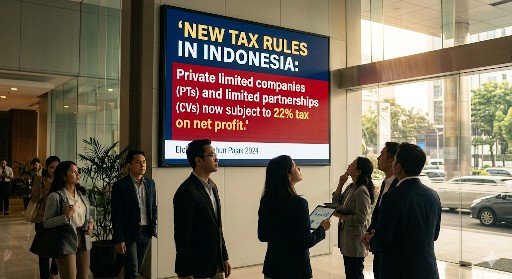
- New tax rules in Indonesia: Private limited companies (VVs) and limited partnerships (CVs) now subject to 22% tax on net profit
- Return to the normal tax system
- Accounting obligation
0.5% tax benefit for SMEs remains - Transition period for existing private limited companies (VVs) and limited partnerships (CVs)
- Impact on businesses
- Strategies companies must implement
New tax rules in Indonesia: Private limited companies (VVs) and limited partnerships (CVs) now subject to 22% tax on net profit
The Indonesian government, under President Prabowo Subianto, has adjusted its corporate tax policy through Government Decree (PP) No. 20 of 2026, which entered into force on April 22, 2026.
This regulation entails significant changes for companies with legal personality, particularly private limited companies (Vv’s) and limited partnerships (CV’s).
LATEST NEWS: Finding business opportunities amidst competition: are there still possibilities for newcomers?
Although many SMEs previously enjoyed the convenience of a final tax of 0.5% of turnover, some companies must now return to the standard tax system with a higher rate and more extensive administrative procedures.
Return to the standard tax system
One of the most important changes in this new regulation is the reintroduction of the corporate income tax rate (PPh) of 22% of net profit for self-employed professionals and limited partnerships.
This means that the tax base is no longer calculated based on turnover or total sales, but on net profit after deduction of operating expenses and other tax-deductible business expenditures.
Under this system, companies are required to maintain clear and transparent financial reports, as tax calculations will be based on these results. Obligation to keep accounts
In addition to the introduction of a tax rate based on net profit, the government also requires self-employed professionals and limited partnerships to maintain proper accounts.
LATEST NEWS: Potential economic crisis in 2027: are real estate and gold at risk of declining in value?
These accounts include:
- Registration of all business transactions.
- Profit and loss accounts.
- Balance sheets.
- Registration of the company’s assets and liabilities.
- Supporting transaction documents.
This requirement is intended to increase transparency and accountability within the company while simultaneously simplifying tax supervision.
For companies that previously maintained only simple records, this change presents both a challenge and an incentive to improve professionalism in business management.
The 0.5% tax scheme for SMEs remains available
However, the government continues to offer low tax benefits to certain business groups.
The final tax rate of 0.5% of turnover can still be utilized by:
- Individual taxpayers.
- Sole proprietorships.
- Cooperatives.
However, this regulation applies only to companies with a maximum annual turnover of 4.8 billion Indonesian rupees.
Companies that choose to operate as a sole proprietorship or cooperative can therefore still benefit from administrative ease and relatively lower tax rates compared to limited liability companies or BVs.
LATEST NEWS: Students need to strengthen their competencies and certification to face the world of work
Transition period for existing PT and CV companies
The government also offers an adjustment period to PT and CV companies established before the entry into force of these regulations.
Private limited companies (VvEs) registered before April 22, 2026, have a transition period of 3-4 years before they fully comply with the standard tax rate of 22%.
This policy is intended to give companies sufficient time to:
- Set up a better accounting system.
- Adjust the company’s financial structure.
- Improve tax administration capabilities.
Understand the new reporting system. Conversely, private limited companies (VvEs) established after April 22, 2026, have no transitional period. From their incorporation, they are subject to the corporate income tax rate of 22% on net profit and are required to maintain full accounting records.
LATEST NEWS: Telkomsel and TVRI offer 100,000 free access points to Bola Gembira MAXStream TV, including the 2026 World Cup
Importance for the business community
This policy change is expected to have various consequences for the business community.
Positive effects
- Promotion of more professional corporate governance.
- Improvement of the habit among entrepreneurs to prepare accurate financial reports.
- Facilitation of access to bank financing thanks to clear accounting.
- Improvement of the transparency and credibility of the company.
Challenges
- Increase in administrative burdens for companies.
- The need for accountants or tax advisors.
- Higher operating costs for accounting.
- Adaptation of financial systems for companies that previously had simple accounting
Conclusion
Government Decree No. 20 of 2026 marks a significant change in the corporate tax system in Indonesia. Individuals with a general partnership (PT) and limited liability companies (CV) are gradually returning to the standard tax rate of 22% of net profit and are required to maintain more accurate accounting records.
At the same time, a final tax benefit of 0.5% of turnover remains available to individual taxpayers, sole proprietorships, and cooperatives with a maximum annual turnover of 4.8 billion Indonesian rupees.
For entrepreneurs, this change means not only a change in taxes but also an impetus to increase professionalism, strengthen financial management, and lay a healthier and more sustainable business foundation for the future. ***tok