
Ad hoc judges at the Industrial Relations Court ensure legal certainty for employees and employers
Minister of Manpower Yassierli emphasized that fair and clear judicial reasoning is crucial for ensuring legal certainty for employees and employers involved in labor disputes.
Ad hoc judges at the Industrial Relations Court play a role in this process by providing perspectives from both employees and employers.
LATEST NEWS: ASUS ExpertBook P3 G1: The ideal business laptop with Intel Core Ultra
According to Yassierli, ad hoc judges—who are themselves either employees or employers—possess experience that can help the panel better understand labor law issues from both viewpoints.
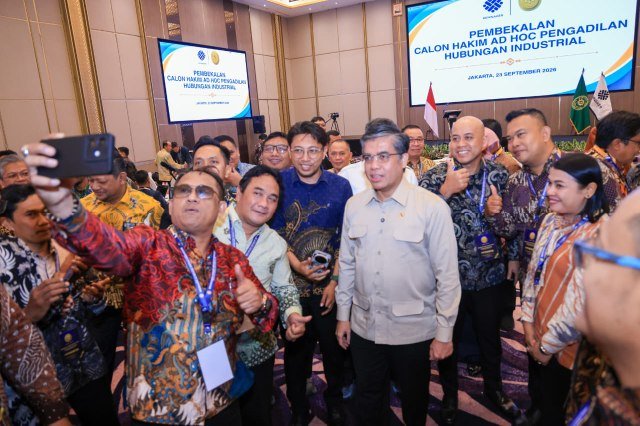
“The presence of ad hoc judges offers an important perspective for understanding labor law issues. Their practical experience can also assist in resolving technical problems that arise in court,” said Yassierli during a meeting for prospective ad hoc judges of the Industrial Relations Court in Jakarta on Wednesday, September 23, 2026.
The event was organized by the Ministry of Manpower’s Directorate General of Industrial Relations Development in collaboration with the Supreme Court’s Directorate General of Courts.
Yassierli explained that, under Law No. 2 of 2004 concerning the Settlement of Industrial Relations Disputes, ad hoc judges are part of the panel that examines and adjudicates labor disputes.
LATEST NEWS: Watch the 2026 Asian Games at no extra cost via IndiHome’s MAXStream TV
Their experience and expertise can assist in analyzing technical issues arising in a case.
“Decisions must take into account the law, existing agreements, customs, and fairness. Therefore, the integrity and professionalism of judges are crucial to maintaining confidence in the resolution of labor disputes,” Yassierli stated. According to Yassierli, the integrity of judges is demonstrated, among other things, by their refusal to intervene improperly and by their equal treatment of all parties during the dispute resolution process.
A fair and clear assessment must provide the parties with certainty when resolving labor disputes.
Furthermore, Yassierli emphasized that labor relations need to shift from a negative-sum game pattern—where the interests of employees and employers are viewed as diametrically opposed—to a positive-sum game pattern that enables both parties to create sustainable shared value.
LATEST NEWS: Do you want to do an internship in Japan? Then foreign language skills are essential
He added that sustainable labor relations must be built through social dialogue, fair treatment, working conditions that foster a sense of safety and well-being, and the involvement of trade unions in resolving workplace disputes.
“Ultimately, we want to move from mere compliance to harmonious and productive relationships, and subsequently create sustainable shared value.
In that process, ad hoc judges of the Industrial Relations Court (PHI) play a crucial role by providing legal certainty and maintaining a balanced perspective,” he said. ***rel
Hakim Ad Hoc Pengadilan Hubungan Industrial Jaga Kepastian Hukum Bagi Pekerja dan Pengusaha
Menteri Ketenagakerjaan Yassierli menegaskan pertimbangan hakim yang adil dan jelas menjadi bagian penting dalam memberikan kepastian hukum bagi pekerja maupun pengusaha yang menghadapi perselisihan hubungan industrial.
Dalam proses tersebut, hakim ad hoc Pengadilan Hubungan Industrial (PHI) berperan memberikan perspektif dari unsur pekerja dan pengusaha.
Menurut Yassierli, hakim ad hoc yang berasal dari unsur pekerja dan pengusaha memiliki pengalaman yang dapat membantu majelis memahami persoalan hubungan kerja dari kedua sisi secara lebih utuh.
“Keberadaan hakim ad hoc memberikan perspektif yang penting dalam memahami persoalan hubungan industrial. Pengalaman praktik yang dimiliki juga dapat membantu mengurai persoalan teknis yang muncul dalam persidangan,” ujar Yassierli dalam Pembekalan Calon Hakim Ad Hoc Pengadilan Hubungan Industrial di Jakarta, Rabu, 23 September 2026.
Kegiatan tersebut dilaksanakan oleh Direktorat Jenderal Pembinaan Hubungan Industrial Kemnaker berkolaborasi dengan Direktorat Jenderal Badan Peradilan Umum Mahkamah Agung.
Yassierli menjelaskan, berdasarkan Undang-Undang Nomor 2 Tahun 2004 tentang Penyelesaian Perselisihan Hubungan Industrial, hakim ad hoc menjadi bagian dari majelis yang memeriksa dan memutus perkara perselisihan hubungan industrial.
Pengalaman dan keahlian yang dimiliki dapat membantu memberikan analisis terhadap persoalan teknis yang muncul dalam perkara.
“Putusan harus mempertimbangkan hukum, perjanjian yang ada, kebiasaan, dan keadilan. Karena itu, integritas dan profesionalisme hakim menjadi bagian penting dalam menjaga kepercayaan terhadap penyelesaian perselisihan hubungan industrial,” kata Yassierli.
Menurut Yassierli, integritas hakim antara lain tercermin dari sikap menolak intervensi dan memperlakukan para pihak secara setara dalam proses penyelesaian perkara.
Pertimbangan yang adil dan jelas diharapkan memberikan kepastian bagi para pihak dalam menghadapi perselisihan hubungan industrial.
Lebih lanjut, Yassierli menekankan hubungan industrial perlu diarahkan dari pola negative sum-game, ketika kepentingan pekerja dan pengusaha dipandang berlawanan, menuju positive sum-game yang memungkinkan kedua pihak menciptakan nilai bersama secara berkelanjutan.
Ia menambahkan, hubungan industrial yang berkelanjutan perlu dibangun melalui dialog sosial, perlakuan yang adil, kondisi kerja yang memberikan rasa aman dan kesejahteraan, serta keterlibatan serikat pekerja dalam penyelesaian persoalan di perusahaan.
“Pada akhirnya, kita ingin bergerak dari kepatuhan minimum menuju hubungan yang harmonis dan produktif, kemudian menciptakan nilai bersama yang berkelanjutan.
Dalam proses itu, hakim ad hoc PHI memiliki peran penting dalam memberikan kepastian hukum dan menjaga keseimbangan perspektif,” ujarnya. ***rel