Minister of Labor emphasizes cooperation between universities and the business sector to address the mismatch between graduate competencies and the needs of the labor market
Minister of Labor Yassierli emphasized the importance of closer cooperation between universities and the business sector to address the mismatch between graduate competencies and the needs of the labor market.
According to data, approximately 33.5 percent of university graduates in Indonesia work in jobs unrelated to their field of study.
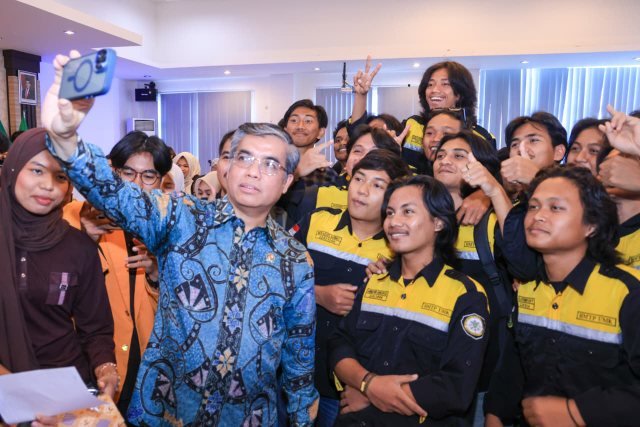
“There is a mismatch for which we are collectively responsible. Universities educate graduates, but their skills often do not align with the needs of the business sector. Therefore, universities must remain closely connected to the business sector,” said Minister of Labor Yassierli during a public lecture at Muhammadiyah University Kendari in Southeast Sulawesi on Wednesday, August 5, 2026.
According to the minister, cooperation between universities and the business sector must be accompanied by a transformation of higher education to produce graduates who are better prepared for the labor market. An important step is to ensure that graduates possess measurable competencies in addition to their academic degrees through competency certification.
Additionally, universities must equip students with communication, collaboration, empathy, and critical thinking skills that cannot be replaced by artificial intelligence (AI).
Students are also encouraged to possess a combination of specific competencies supported by a general competency (M-shaped), enabling them to respond better to changes in the labor market than if they focused exclusively on a single specialization.
LATEST NEWS: Gold Price Forecast (XAU/USD) August 2026: Is a crazy gold rally still possible?
To support this effort, the Ministry of Labor continues to expand the National Internship Program, or MagangHub. The aim is for this program to reach 150,000 participants in 2026, an increase of 50,000 participants compared to the previous year.
Participants in the program receive compensation equal to the minimum wage for six months while gaining direct work experience in the business sector.
“The National Internship Program, or MagangHub, is a major investment and proof of the government’s commitment to closing the gap between graduates’ competencies and the needs of the business community,” stated the Minister of Labor.
The Minister added that graduates’ readiness for the labor market is also determined by a mindset that adapts to change. Therefore, students must develop three key mindsets: a growth mindset to keep learning, a future-oriented mindset to adapt to changing times, and an innovative mindset to continuously generate new ideas and solutions.
LATEST NEWS: University of the Republic of Indonesia: A new architecture for training national leaders
“The world is changing rapidly. As many as 39 percent of skills will change over the next six years. Students must not stop learning in the lecture hall,” he concluded.
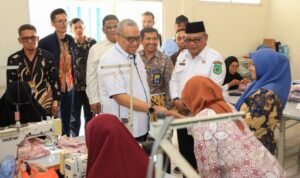
On the same occasion, the Minister of Labor also emphasized the ministry’s commitment to increasing access to competency development for the residents of Southeast Sulawesi.
Following consultation with the Governor of Southeast Sulawesi, the Ministry of Labor has decided to increase the number of participants in free vocational training and certifications this year from 2,000 to 10,000. This certification is issued by the National Agency for Vocational Certification (BNSP) and is nationally recognized. ***rel