
Editor’s Note
- Prabowo’s ‘one-stop’ policy for the export of strategic raw materials via state-owned enterprises will erode investor profits
- Proposed new policy: Export of raw materials via state-owned enterprises
- Three key government goals
- Investor concerns regarding Prabowo’s policy
- Stock market volatility and monopolies
- Double impact on the Rupiah
- Reform or a worsening of the situation?
Prabowo’s ‘one-stop’ policy for the export of strategic raw materials via state-owned enterprises will erode investor profits
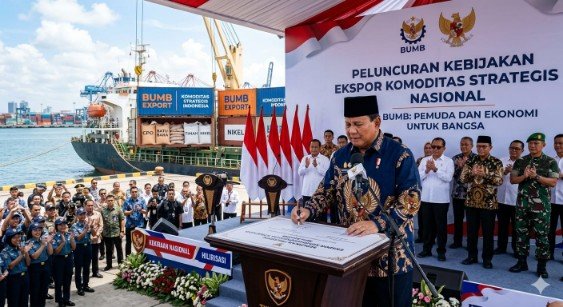
The Indonesian government has proposed a sweeping new policy that mandates the export of strategic raw materials through a single state-owned enterprise (SOE).
The policy, announced by Indonesian President Prabowo Subianto, aims to withdraw foreign currency from exports (DHE) to local banks, prevent tax evasion, and strengthen Indonesia’s bargaining position on the global market.
LATEST NEWS: 5 natural drinks for kidney cleansing: analysis and benefits for the body
However, the policy has also raised concerns among investors and market participants, particularly regarding potential monopolies, slow bureaucracy, and negative consequences for the stock market.
Although a strengthening of the rupiah is possible in the medium term if this policy is successful, many technical details remain unclear. This raises questions about whether this will be a successful reform or will actually make the sector more complex.
Proposed new policy: Commodity exports via state-owned enterprises
The government is considering introducing a new policy that requires the export of strategic commodities (such as coal and palm oil) to proceed exclusively through a single channel, namely designated state-owned enterprises.
This policy represents a fundamental paradigm shift, not merely a minor adjustment to regulations.
LATEST NEWS: Minister of Manpower emphasizes that employees must strengthen innovation amid global changes
Large private companies will no longer be able to export directly to international buyers; everything must go through a single state exporter.
This idea arose from President Prabowo’s concern that Indonesia’s natural resources are being sold, but that a large portion of the proceeds is being siphoned off to foreign banks. The goal is to channel this money back into the domestic economy.
Three main government objectives
1. Forcing foreign currency revenues from exports (DHE) into local banks: This is expected to increase the country’s dollar reserves.
2. Closing tax loopholes: Addressing the practice of under-invoicing (selling at a higher price than the tax return), which has led to trillions of rupiah in lost state revenue.
3. Strengthening Indonesia’s bargaining position on the world stage: By channeling large quantities of goods through a single state-owned enterprise, the government hopes to be able to monitor market prices more accurately and even set prices comparable to OPEC.
LATEST NEWS: Gold Price Forecast and Analysis Today, Wednesday, May 20, 2026: Wait and See
Investor concerns regarding Prabowo’s policy
Disruption of free market mechanisms: International investors fear that government intervention will disrupt the efficient functioning of the free market.
Slow and cumbersome bureaucracy: There are concerns about the rise of an inefficient bureaucracy. Eroded profit margins: Private entrepreneurs fear that their profits will decline due to the dominance of state-owned enterprises.
Reduced export efficiency: There are fears that overall export efficiency will decrease.
LATEST NEWS: Moringa leaves are more effective than garlic for cleansing blood vessels
Stock volatility and monopolies
Stock volatility: Major coal and palm oil companies (such as Adaro, Bumi, Bayan, ITMG, Astra Agro, and Smart) may lose their freedom to sell their products independently, which will cause uncertainty and stock volatility.
Monopoly risk: Investors are concerned about monopoly risks, port queues, rigid pricing, additional costs for state-owned enterprises, and the possibility of political favoritism.
Multiple effects on the Rupiah
Short term: Potential market shocks and capital outflows resulting from concerns among foreign investors, which could depress the Jakarta Composite Index (JCI).
Medium term: If the policy is successful, the Bank of Indonesia will possess ample dollar reserves, enabling a stronger rupee and making the import of goods cheaper and inflation-fighting.
LATEST NEWS: Building a business empire while sitting back: myth or reality?
Reform or make it more complicated?
Uncertainty regarding technical details: The success or failure of this policy depends heavily on technical details that have not yet been disclosed.
Critical questions: Will this policy ensure strict, full control or merely an intermediary? Will exporters still be allowed to seek their own customers?
The dilemma: Will this step restore Indonesia’s prosperity or will it stifle the most profitable industry with cumbersome bureaucracy? ***tok