

Editor’s Note
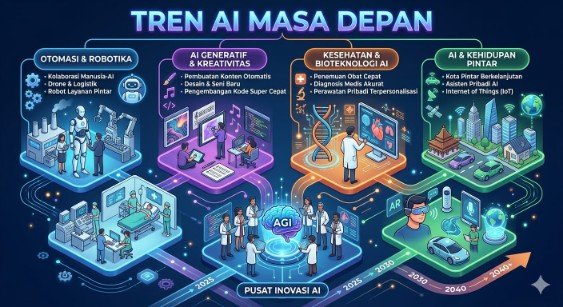
- 6 Key AI Trends for the Future
- AI Models Becoming Commonplace Workflows More Important Than
- Autonomous Agents
- Technical Gap
- The Importance of Context
- The Future of AI in Advertising
- How Will AI Enter the Physical World?
6 Key AI Trends for the Future
According to data from leading institutions such as McKinsey, OpenAI, and Stanford, the rules of the game for AI are changing completely.
The AI we know today, whether it is Chat GPT, Gemini, or something else, will feel very different in a few years. To stay ahead of developments, we must understand these fundamental changes.
Here are six AI trends that will evolve in the future. First, how AI models are becoming commonplace. Second, why workflows are more important than autonomous agents. Third, closing the technical gap.
Fourth, the importance of context. Fifth, the future of AI in advertising. And finally, sixth: how will AI enter the physical world?
AI models are becoming a commodity
We used to discuss which AI model was the best. But you know what, that discussion is quickly becoming obsolete. The focus has shifted drastically.
The change in thinking is palpable. We used to be obsessed with benchmark scores – who was number one? Application was therefore much more important than the pure computing power of the model itself.
And this is not just an opinion; the data supports it. This graph, based on a human-made analysis, shows how the performance of the best AI models is becoming increasingly similar.
They are all getting smarter, but the difference between them is narrowing. Even free models like Llama now perform almost as well as paid models.
The analogy is striking. If something becomes cheap and of equal quality, it becomes a commodity, like electricity. We don’t care who the electricity supplier is; what counts is that we can use it for what purpose.
Well, the same thing is happening again now with AI models. So, what is their use? The competition has changed. OpenAI wins because everyone knows the name. Google wins because Gemini is ubiquitous, in Gmail, Google Search, and even Android.
Entropic won because they focused on specific customers. None of them won simply because they had the best AI.
So, stop obsessing over scores. Focus on finding what works best for you.
Workflow is more important than autonomous agents
We often hear about AI agents, super-smart programs that can work independently. But the truth is that the real value of AI today lies in workflow.
That is to say, AI that helps us perform specific tasks more easily and quickly.
According to McKinsey, less than 10% of companies actually use autonomous agents. Meanwhile, data from OpenAI shows that 20% of AI usage in these companies takes place via specific workflow tools, such as custom GPT.
It is clear that the market has made its choice; practical solutions are more attractive than the promise of full autonomy. And the impact is significant.
Pharmaceutical companies are using AI to analyze data faster. Energy companies can reduce call center costs, and banks can modernize their systems more quickly.
These are small successes, but combined, they could be worth billions of dollars. However, a quote from AI expert Andrej Karpathy reminds us to remain realistic. Multitasking agents still present many challenges, especially when it comes to data security.
So, we are in the decade of the agent, not the year of the agent. Focus on proven, reliable workflows today.
Technical divide
AI is starting to break down the boundaries between technical and non-technical work. As a result, more and more people can do things that once seemed impossible.
The OpenAI figures are incredible. 75% of AI users in companies say they can now perform entirely new tasks, and not just speed up old ones.
Sales and marketing teams can now write simple scripts or create data dashboards themselves without the help of IT staff. In fact, research from MIT confirms this.
AI acts as an equalizer, and those with fewer technical skills benefit the most from this. This allows them to catch up with experts. We call this the democratization of technical skills. So, here is a small challenge for you.
Try choosing a technical task this month that you normally avoid. For example, cleaning up messy data or creating automated reports, and try to solve it using AI. You will be amazed by the results.
The importance of context
We have been so busy learning how to organize the perfect prom. But in 2026, that will no longer be so important.
What is much more important is providing the right background information to AI. This is a major problem, the so-called fact gap.
AI models might know everything about world history, but they do not know the content of the email your boss just sent. They are like the most brilliant employee, but they have no access to company files.
Without context, they are useless. So, there are two things you can do immediately. First: keep your files organized. This is no longer optional, but mandatory.
If files are messy, AI will struggle to find them. Second: collect your information. If your CV is in Google Drive, but your interview notes are in Notion, how can AI help you connect everything?
The future of AI with advertisements
This fifth point might be somewhat controversial, but it is inevitable: advertisements will make their way into chatbots. And although no one likes advertisements, they might not be as bad as they seem. Without advertisements, the most advanced AI models will only be available to people with expensive subscriptions. This could widen the digital divide.
But if there were an ad-driven version, everyone—students, volunteers, and ordinary users—would have access to the best technology. Just like we can watch top video creators on YouTube for free, right?
How is AI starting to penetrate the physical world?
So far, we have discussed AI as software, but by 2026, we will see software increasingly often in the real world in the form of robots and other physical machines.
The proof is that it is already everywhere. Waymo’s self-driving taxis have already covered millions of kilometers and have a significantly lower accident rate. Robots in Amazon warehouses deliver incredibly fast, and China…
They are deploying more industrial robots than the United States and the rest of the world combined. This is truly changing the way we view physical goods.
Analyst Mary Meeker calls it a capital good as a software endpoint. This shift is already taking place on a large scale. This means that the value of a car or robot is not just decreasing.
Just like our phones, they are becoming increasingly advanced platforms over time thanks to software updates. Waymo’s cars are much smarter today than they were two years ago, even though they have essentially remained the same.
Summary
As Professor Ethan Molik aptly put it, we find ourselves at a unique moment, because AI is still new and complex, and no single expert knows everything. In fact, this is a golden opportunity for all of us. ***tok